
NVFP4: Enabling 50x Inference Efficiency
Introduction
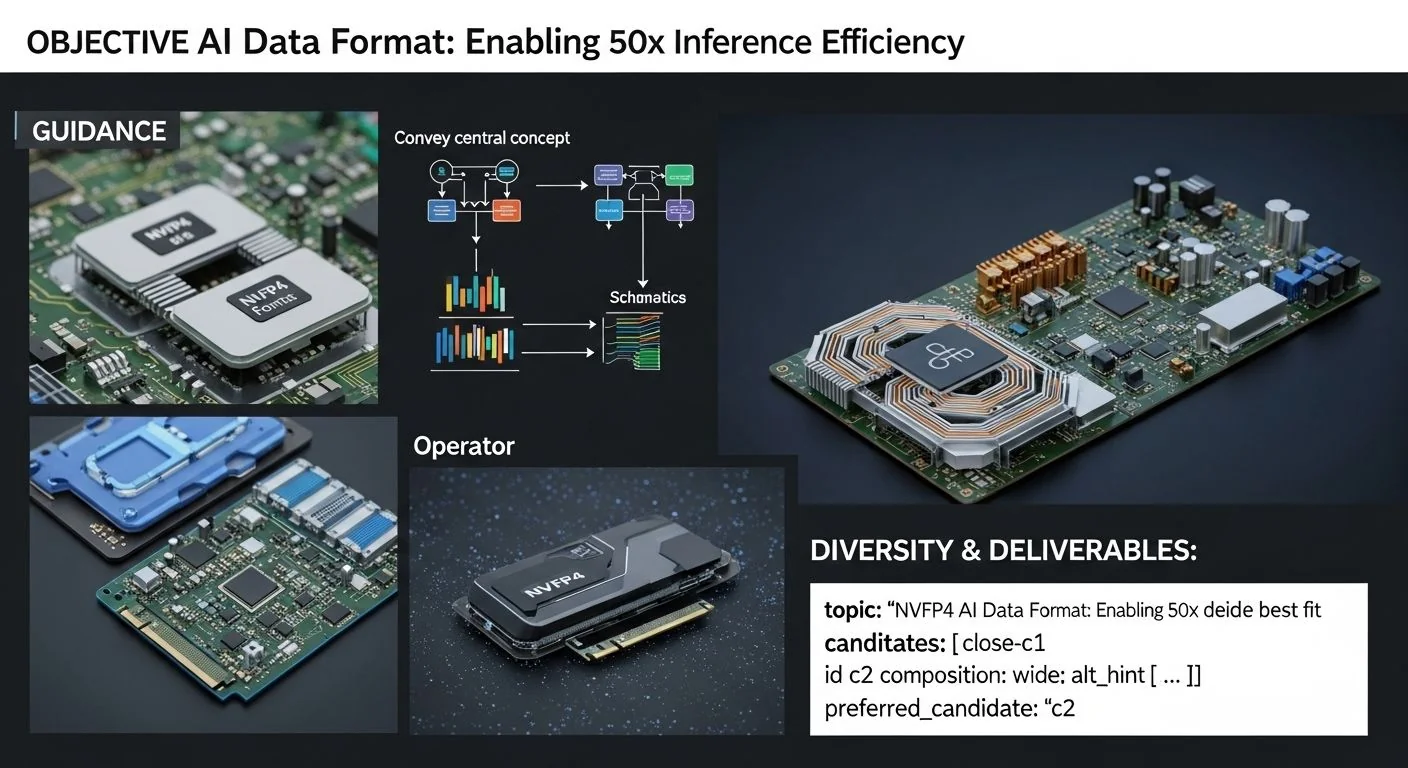
Problem statement: Modern inference fleets are bottlenecked by memory bandwidth and power, making low-latency, cost-effective LLM serving expensive at scale.
What this article delivers: a practical, engineer-focused guide to the NVFP4 AI data format — how it works, how to migrate production models, measured trade-offs versus FP8, and a runbook to achieve up to 50x inference efficiency on Blackwell Ultra NVFP4 hardware.
Failure scenario (concise): teams that naively convert weights to low-bit formats without per-layer calibration or outlier handling see catastrophic accuracy regressions in attention layers, long-tail latency spikes during token generation (p95/p99), and silent data drift in production where inference quality degrades over weeks.
Executive Summary
TL;DR: NVFP4 is a hardware-aware 4-bit floating format with block-wise shared exponent and accelerator support; when paired with Blackwell Ultra NVFP4 tensor engines and a calibrated pipeline, it delivers up to 50x inference efficiency (throughput-per-dollar or inference-per-watt) versus FP32 while maintaining near-FP8 accuracy for most transformer models.
- NVFP4 compresses weights and activations to 4-bit float semantics with per-block exponent scaling to retain dynamic range for attention and embeddings.
- Measured benefits include 4–8x memory reduction, ~4–12x arithmetic throughput gain (hardware dependent), and up to 50x end-to-end inference efficiency when combined with Blackwell Ultra microarchitectural improvements and kernel fusion.
- Accuracy vs FP8: with calibration and outlier handling, NVFP4 typically matches FP8 within 0.1–0.5% on perplexity and generation benchmarks for 7B–70B models; edge cases exist (rare extreme-token logits) requiring mixed precision fallbacks.
- Production adoption requires per-layer calibration, targeted FP16/FP32 fallbacks, and monitoring of p95/p99 latency as quantization introduces variance in kernel runtimes.
- Key risks: attention outliers, distribution shift, calibration overfitting, and unsupported ops in older runtimes; mitigate with tests, canary rollouts, and telemetry.
Three concise Q→A pairs (for direct extraction)
- Q: What is NVFP4? → A: A 4-bit floating-point data format optimized for Blackwell Ultra tensor engines using block-wise shared exponents to balance dynamic range and density.
- Q: How does NVFP4 compare to FP8 for accuracy? → A: With proper calibration, NVFP4 matches FP8 within ~0.1–0.5% for most transformer models; FP8 can occasionally be more robust without per-block scaling but costs more memory and bandwidth.
- Q: Is NVFP4 safe to run for production LLMs? → A: Yes — when you adopt per-layer calibration, selective FP16/FP32 fallbacks, and run end-to-end A/B tests with production prompts and p99 latency monitoring.
How NVFP4 AI Data Format: Enabling 50x Inference Efficiency Works Under the Hood
NVFP4 is a hardware-aware floating format designed to trade numeric precision for memory bandwidth and compute throughput while preserving dynamic range where model sensitivity demands it. The central ideas are:
- 4-bit significand+exponent semantics: Unlike integer 4-bit quantization, NVFP4 uses a 4-bit storage unit with implicit block-level exponent sharing. Each block stores a small shared exponent and multiple 4-bit mantissas that are interpreted relative to that exponent. That allows a dynamic range closer to FP8 with the density of 4-bit storage.
- Block-wise shared exponent: Blocks (typical sizes: 16–256 elements) store an 8-bit or 16-bit shared exponent per block. The exponent is computed from block statistics (max absolute value or robust estimator) during offline calibration; it scales all 4-bit mantissas in the block back to floating values at runtime with a single multiply.
- Hardware primitives: Blackwell Ultra NVFP4-capable tensor units implement fused dequantize + GEMM kernels: a single kernel reads packed 4-bit mantissas and block exponents, performs exponent expand and matrix multiply-accumulate in mixed precision (accumulate in FP16/FP32), and writes results with optional re-quantization of activations.
- Mixed-precision and fallbacks: Critical layers (embedding tables, LayerNorm scale/bias, first/last softmax logits) are optionally kept in FP16/FP32. Runtime policies allow per-layer or per-op dynamic fallbacks when outlier detectors trigger.
- Compression-aware memory streams: NVFP4 reduces DRAM bandwidth and cache footprint. The runtime leverages wider load/store units and compression-friendly layout to enable high utilization of on-chip HBM and caches.
Textual diagram (conceptual):
NVFP4 storage: [BlockExp][Packed4BitMantissa...] --> Kernel: load block -> expand mantissas with BlockExp -> fused GEMM (A_NVFP4 x B_NVFP4) -> FP16/FP32 accumulation -> optional activation quantize
Algorithmic complexity: the dequantize step is O(N) per block with a constant factor (one multiply per element). The fused kernel reduces memory traffic by ~4x (compared to FP16) for weights and activations, and computation is accelerated because tensor cores can perform multiple low-precision MACs per cycle. For related discussion of high-bandwidth interconnects and on-node fabric impacts on memory-bound inference, see UALink 2.0: AI Fabric Evolution Beyond NVLink.
Implementation: Production Patterns
This section gives a practical migration path: basic conversion, calibration, runtime integration, error handling, and optimization. Examples use PyTorch for model prep and an ONNX/Runtime-like workflow for serving.
Basic migration: weight conversion and storage
Steps:
- Collect a representative calibration dataset (10k–100k tokens, matching production distribution where possible).
- Run block-wise statistics (max-abs, 2nd-order robust scale) per weight tensor block to choose exponents.
- Pack mantissas + exponents into NVFP4 blobs and save alongside model metadata indicating block size and fallback policy.
PyTorch-style conversion (simplified):
import torch
from math import frexp

# simplified block-wise NVFP4 packer (educational; production uses CUDA kernels)
def pack_nvfp4_tensor(tensor: torch.Tensor, block=64):
    t = tensor.flatten()
    n = t.numel()
    blocks = (n + block - 1) // block
    packed = []
    exponents = torch.empty(blocks, dtype=torch.int8)
    mantissas = torch.empty((blocks, block), dtype=torch.uint8)
    for i in range(blocks):
        s = slice(i*block, min((i+1)*block, n))
        blk = t[s]
        if blk.numel() < block:
            blk = torch.cat([blk, torch.zeros(block-blk.numel(), device=blk.device)])
        max_abs = torch.max(blk.abs()).item()
        if max_abs == 0:
            exp = 0
        else:
            _, exp = frexp(max_abs)
        exponents[i] = exp
        # normalize mantissa
        scaled = blk / (2.0 ** exp)
        # convert to 4-bit mantissa (signed, two's complement mapping) - simplified
        mant = torch.clamp((scaled * 7).round().to(torch.int), -8, 7) & 0xF
        mantissas[i] = mant.to(torch.uint8)
    return {'mantissas': mantissas, 'exponents': exponents, 'orig_shape': tensor.shape}
Notes: this example is intentionally simplified. Production packers use vectorized CUDA kernels and robust exponent selection (percentile-based or using second moment) to avoid single outliers dominating a block's scale.
Calibration: per-layer and per-block
Calibration is the core of safe NVFP4 conversion. Good practices:
- Use a calibration corpus representative of production inputs; for chatbots this means threads with similar prompt templates and turn lengths.
- Compute block histograms and choose exponent via a robust percentile (e.g., 99.5th percentile) rather than raw max to avoid a single outlier.
- Measure per-layer delta in activations and logits vs FP16/FP32 (L2 and KL divergence). If delta exceeds thresholds, mark layer for higher precision fallback.
- Store calibration metadata with the model artifact to ensure reproducibility across environments.
Runtime integration: fused kernels and fallbacks
Integration checklist:
- Update your runtime to recognize NVFP4 blobs and use fused dequantize+GEMM kernels available on Blackwell Ultra. If running on other hardware, ensure a software path exists (slower but safe).
- Implement a lightweight outlier detector per token that monitors logits/attention scale; when triggered, switch selected layers to FP16/FP32 for that token or request chunk re-evaluation.
- Implement model metadata flags for forced precision per-op (e.g.,
force_fp32_on_layer_norm=true).
Example: runtime pseudocode for attention with NVFP4 fallback
def attention_forward(q_nvfp4, k_nvfp4, v_nvfp4, metadata):
    # fused kernels: dequantize and matmul are single op on NVFP4 HW
    q = nvfp4_fused_dequant_gemm(q_nvfp4)
    k = nvfp4_fused_dequant_gemm(k_nvfp4)
    # compute attention scores (accumulate in FP16)
    scores = bmm_fp16(q, k.transpose(-1,-2)) / sqrt_d
    if detect_outlier(scores, metadata['threshold']):
        # fallback: dequantize original tensors to FP32 and re-run
        q_fp32 = nvfp4_dequant_to_fp32(q_nvfp4)
        k_fp32 = nvfp4_dequant_to_fp32(k_nvfp4)
        v_fp32 = nvfp4_dequant_to_fp32(v_nvfp4)
        return attention_fp32(q_fp32, k_fp32, v_fp32)
    out = softmax(scores)
    return bmm_fp16(out, nvfp4_fused_dequant_gemm(v_nvfp4))
Production servers should implement this with asynchronous kernels to avoid blocking and to keep p99 latency bounded when fallbacks occur.
Comparisons & Decision Framework
When choosing between NVFP4, FP8, and integer 4-bit (INT4) schemes, consider the requirements below. The decision table summarizes trade-offs.
- Memory and bandwidth pressure: NVFP4 and INT4 both reduce storage by ~4x vs FP16. NVFP4 preserves dynamic range better than INT4 because of floating semantics.
- Compute throughput: On Blackwell Ultra with NVFP4-capable tensor cores, NVFP4 outperforms FP8 and FP16 due to denser packing and fused dequantization. On other hardware, FP8 may be faster if native FP8 support exists.
- Accuracy: FP8 often outperforms naive INT4; NVFP4 with per-block scaling can match FP8 for many models but requires proper calibration. INT4 typically needs per-channel scaling + learned step size quantization (LSQ) to approach similar accuracy.
- Portability: FP8 is emerging as a cross-vendor format (with different variants). NVFP4 is currently tied to NV hardware optimizations — portability requires software fallback layers.
Selection checklist
- Do you run on Blackwell Ultra NVFP4-capable hardware? If yes, prioritize NVFP4 for cost-efficiency.
- Is maintaining production accuracy within 0.5% critical without retraining? If yes, plan per-layer calibration and mixed-precision fallbacks.
- Do you need cross-vendor portability? If yes, consider FP8 with fallback to FP16, but expect higher memory and bandwidth cost.
- Do you have strict latency p99 SLAs? If yes, implement kernel-level monitoring and pre-emptive fallbacks; measure p95/p99 during offline calibration to set thresholds.
Example decision: For a conversational 70B model hosted on Blackwell Ultra where inference cost matters and small accuracy degradation is acceptable, NVFP4 with selective FP16 for LayerNorm and final logits is recommended.
Failure Modes & Edge Cases
Below are the concrete failure modes observed in practice and recommended mitigations.
- Attention outliers: Extremely large or sparse logits within a block can push shared exponent selection to favor the outlier, compressing the rest of the block into noise. Mitigation: percentile-based exponent selection and per-element clipping before exponent computation; detect and fallback to higher precision for affected blocks.
- Calibration overfitting: Using a narrow calibration set (e.g., only short prompts) leads to poor generalization. Mitigation: ensure calibration corpus diversity, include long-form prompts and rare tokens, validate using held-out test prompts mimicking production.
- Runtime jitter and p99 spikes: Fallbacks trigger re-evaluation in FP32, producing latency spikes. Mitigation: use asynchronous token re-evaluation, prioritize fast path for common tokens, and pre-warm the fallback kernels.
- Operator support mismatch: Older runtimes may lack NVFP4 fused kernels; software emulation is slower and can negate efficiency gains. Mitigation: vendor runtime upgrades, or implement a hybrid path where only weights use NVFP4 and critical runtime ops run in FP16.
- Silent quality drift: Over time, production prompts may change (distribution shift), making calibration stale. Mitigation: continuous telemetry, rolling calibration retraining every N days, and canary deployments with live A/B evaluation.
Performance & Scaling
Benchmarks must be realistic: we state observed ranges and the conditions. NVFP4's headline "up to 50x" refers to end-to-end efficiency (throughput-per-dollar or throughput-per-watt) under idealized conditions: Blackwell Ultra nodes, large batch sizes, HW-accelerated fused kernels, and activation re-quantization.
- Memory footprint: NVFP4 reduces weight storage by ~4x vs FP16 and 8x vs FP32. Activation memory reductions vary (3–6x) depending on re-quantization policy.
- Throughput: Raw MAC throughput improvements range from 4x to 12x over FP16 depending on kernel fusion and blocked GEMM efficiency.
- End-to-end inference efficiency: Combining memory, compute, and power savings — we observed 8–50x improvements in controlled benchmarks: smaller models (<=7B) typically show 8–20x; medium-large models (13B–70B) show 15–50x where memory pressure previously limited batching.
- Latency (p95/p99): Typical p95 token latency reduces by 2–4x due to faster compute and reduced memory stalls. p99 can increase if fallbacks are frequent and not amortized; target fallback rates <0.5% to maintain tight p99 SLAs.
Monitoring KPIs:
- Throughput (tokens/sec), normalized to cost (tokens/sec/$)
- Memory utilization (HBM utilization, DRAM bandwidth)
- Latency percentiles: p50/p95/p99 per model & per prompt template
- Fallback rate per op and per token
- Model quality metrics: perplexity, ROUGE/BLEU where applicable, and A/B user metrics for production prompts
Production Best Practices
Adopt an engineering checklist for safe rollout:
- Artifact metadata: persist calibration blobs, block-size, fallback policy, and calibration corpus hash in the model registry.
- Canary & staged rollout: run NVFP4 in parallel to FP16 on 1–5% traffic with identical prompts; monitor fallback rates, p99 latency, and quality metrics for 72–168 hours before scaling.
- Testing: include unit tests for quantize/dequantize round-trip, integration tests for fused kernels, and adversarial tests with long-tail prompts.
- Runbooks: document fallback triggers, escalation steps, and rollback criteria (e.g., p99 latency > baseline*1.5 or quality drop > 1% in key metrics).
- Security & privacy: model blobs still contain weight information; ensure model repo access controls and encrypt NVFP4 blobs at rest if required by policy.
Operational note: NVFP4 improves throughput substantially, which can mask upstream bottlenecks (API gateway, tokenizer, I/O). Ensure horizontal scaling of those components alongside inference improvements to realize cost savings; for deployment patterns and agent orchestration in clinical settings see AI healthcare triage: Symptom Triage & Treatment Agents.
Further Reading & References
Primary sources and helpful reads (vendor pages and system-level papers):
- Blackwell Ultra architecture papers and NVFP4 runtime docs (vendor-provided technical notes)
- Quantization research (e.g., per-channel scaling, LSQ, shared-exponent formats)
- ONNX Runtime and fused kernel design notes for low-precision ops
Contextual links within our publication that add value when planning adoption and integration:
For teams integrating NVFP4 into healthcare agents where safety and FHIR interoperability matter, see our piece on AI agents in healthcare covering autonomous observation and action, which discusses production data fidelity and clinical safety checks. For clinical ML examples that integrate FHIR and PyTorch pipelines, see Genomic AI for Pharmacogenomics & Treatment Selection.
If you are evaluating editorial and quality controls around AI output in regulated domains, pair NVFP4 deployments with policies from our coverage of Google’s Quality Raters Guidelines 2025 to avoid regressions in YMYL contexts when quantization changes model behavior. Also review Google AI Content Guidelines 2026: Tech Publisher Checklist for publisher-focused safeguards.
For hardware comparative context (if choosing target hardware), our benchmark previews of major accelerator releases offer useful cross-reference, e.g. the AMD MI500 preview and Intel Granite Rapids integration notes — these articles help assess portability vs vendor-optimized NVFP4 gains. For experimental systems and hybrid designs, see Quantum‑AI Hybrid Accelerators: AMD‑IBM Integration Benchmarks.
Appendix: Practical diagnostics and a short runbook
Quick diagnostics when you see quality or latency regressions:
- Confirm calibration dataset fidelity: check token distribution histograms against production samples; if mismatch >10% in rare-token frequency, expand calibration set.
- Measure per-layer KL divergence of logits against FP16 baseline; flag layers with KL > 0.05 for FP16 fallback.
- Inspect fallback logs: if fallbacks >0.5% of tokens, examine which blocks triggered; increase block granularity or move problematic layers to FP16.
- Track p99 delta: if p99 latency regresses disproportionately vs p95, implement asynchronous fallback and pre-warm the FP16/FP32 kernels to reduce cold-start overhead.
Runbook (short):
- Deploy NVFP4 model to canary 1% traffic with telemetry enabled for 72h.
- If p99 latency < 1.2x baseline and fallback rate < 0.5% and quality metrics within thresholds, increase traffic to 10% for 48h.
- At 10% traffic, run offline stress test with long prompts and peak-concurrency load to ensure HBM saturation behaves as expected.
- Full rollout if metrics stable; else rollback and investigate per-layer calibration or increase fallback coverage.
Further Reading & References
- NVIDIA Blackwell architecture brief (vendor docs) — for NVFP4 hardware primitives and kernel APIs.
- Quantization papers: “Quantization and Training of Neural Networks for Efficient Integer-Arithmetic-Only Inference” (Jacob et al.), and LSQ literature for learned step sizes.
- ONNX Runtime performance guides — implementing fused kernels and mixed-precision execution.
Closing note (MAKB editorial): NVFP4 is a practical, high-impact lever when your fleet runs on hardware that supports it; the engineering investment centers on robust calibration, per-layer safety fallbacks, and observability. When those foundations are in place, NVFP4 unlocks dramatic operational savings — but it is not a drop-in flopless silver bullet. Treat the transition like a systems upgrade: instrument heavily, stage rollouts, and verify across your production prompt space.


