
Do We Have Quantum Computers? What's Real in 2024
Introduction
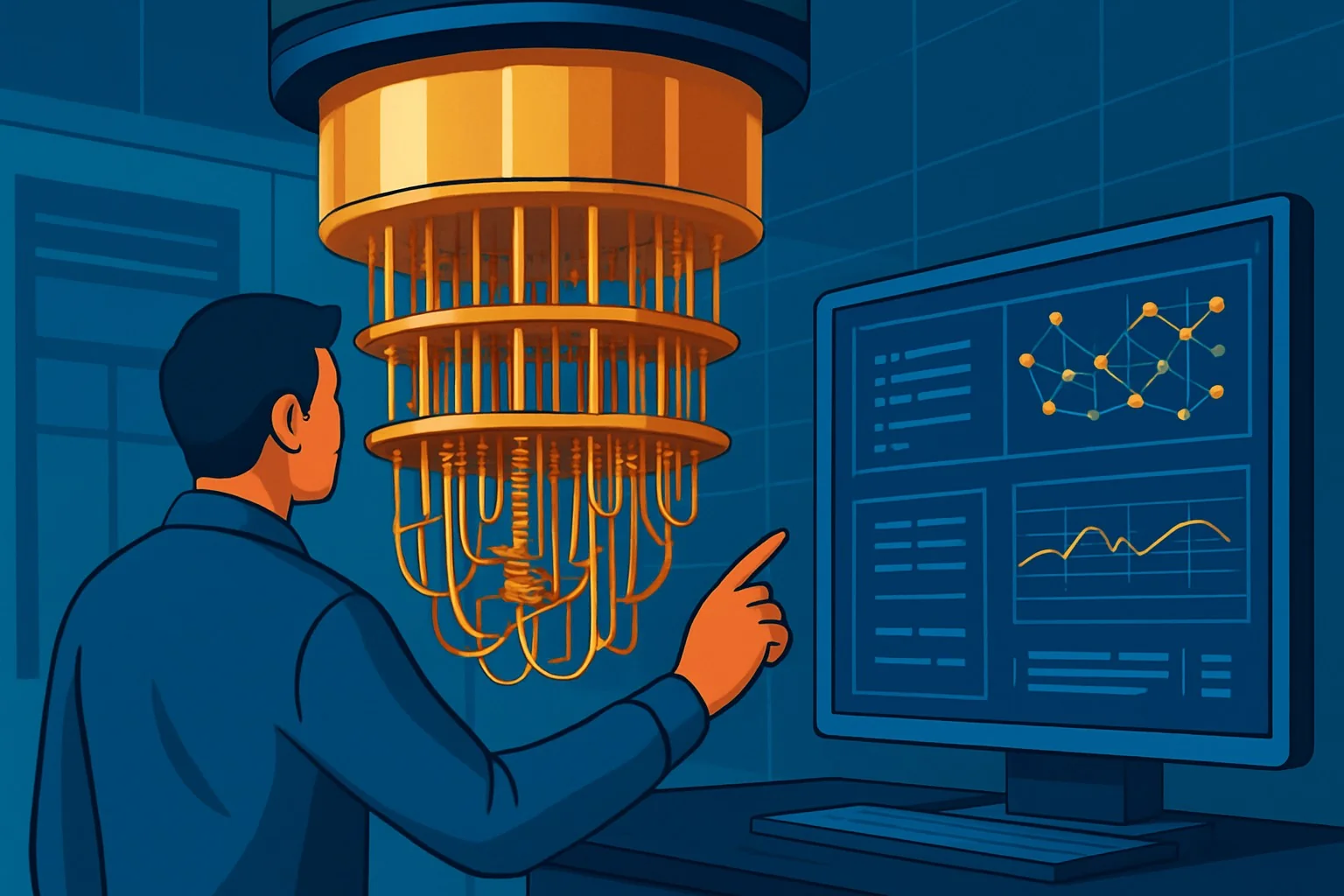
Every week, another headline declares quantum supremacy achieved—yet your infrastructure team still provisions classical EC2 instances. The gap between announcement and operational reality creates genuine confusion among senior engineers evaluating emerging technology roadmaps. This article delivers an evidence-based assessment of what quantum computing hardware actually exists today, what it can demonstrably do, and which critical capabilities remain missing that prevent mainstream production deployment.
Failure scenario: A Fortune 500 technology director allocated $2.3M to a "quantum-ready" supply chain optimization project in 2023, only to discover that the vendor's "quantum" solver was classical simulated annealing with quantum branding. The actual quantum hardware available could not handle their 14,000-variable problem. By the time this was validated through independent benchmarking, the competitive window had closed. This is the cost of conflating quantum computing's genuine experimental progress with production capability.
Executive Summary
TL;DR: Yes, quantum computers exist as experimental physics platforms with 50–1,000+ qubits, but no general-purpose quantum computer can yet solve commercially valuable problems faster than optimized classical systems; the gap is narrowing for narrow use cases while remaining vast for general computation.
Key Takeaways
- Gate-model quantum computers with 50–1,000+ physical qubits exist in cloud-accessible form from IBM, Google, IonQ, Rigetti, and others, but error rates of 0.1–1% per gate operation prevent deep circuits.
- Quantum annealers (D-Wave) with 5,000+ qubits solve specific optimization formulations and have demonstrated quantum advantage in narrow benchmarks, though commercial advantage remains contested.
- No quantum computer currently implements fault-tolerant error correction at scale; surface code demonstrations remain below the logical error threshold for meaningful computation.
- The "quantum winter" risk is overstated for hardware progress but accurate for near-term revenue expectations; 2024–2027 represents the NISQ (Noisy Intermediate-Scale Quantum) era with limited application scope.
- Classical simulation of quantum systems remains competitive for sub-60 qubit problems, creating a moving target for "quantum advantage" claims.
- Production integration requires treating quantum processors as exotic co-processors with 99.9%+ classical overhead, not replacements for existing infrastructure.
Direct Answer Pairs
- Q: Do quantum computers exist that I can use today? A: Yes—IBM, Amazon Braket, Google, and others provide cloud access to gate-model and annealing systems, though all require specialized programming models and have severe circuit depth limitations.
- Q: Can quantum computers break encryption now? A: No—Shor's algorithm requires thousands of fault-tolerant logical qubits; current systems have at most tens of logical qubits in early error-correction demonstrations, with cryptographically relevant scale estimated at 10+ years away.
- Q: Why aren't quantum computers mainstream for business? A: The combination of high error rates, limited qubit connectivity, extreme operating requirements (15 millikelvin for superconducting, ultra-high vacuum for trapped ion), and the absence of demonstrated commercial speedups for broad problem classes keeps them in research and pilot phases.
What Exists Today: Hardware Taxonomy and Verified Capabilities
To answer whether we have quantum computers, we must first define what counts. The field contains three distinct hardware categories with radically different capabilities, limitations, and evidence bases.
Category 1: Gate-Model Universal Quantum Computers
These systems implement arbitrary quantum circuits using single- and two-qubit gates, theoretically capable of any quantum algorithm including Shor's, Grover's, and quantum simulation. Verified deployments include:
- IBM Quantum: Heron processor (133 qubits, ~0.1% two-qubit gate error, heavy-hex lattice); Flamingo roadmap targets 1,000+ qubits by 2025 with modular architecture.
- Google Sycamore: 70-qubit processor; 2019 "quantum supremacy" demonstration (random circuit sampling, 53 qubits) verified; 2024 error-correction milestone with surface code below threshold on 49 physical qubits forming one logical qubit.
- IonQ Forte: 36 algorithmic qubits (AQ 36) with all-to-all connectivity via trapped ytterbium ions; gate fidelities ~99.9% but slower operation (~10 kHz vs. ~1 GHz for superconducting).
- Rigetti Ankaa-2: 84 qubits, superconducting, with active reset and fast readout; focused on hybrid quantum-classical algorithms.
Critical constraint: circuit depth. With ~0.1% error per gate, a 1,000-gate circuit has ~37% probability of error-free execution (0.999^1000 ≈ 0.368). Most valuable quantum algorithms require 10^6–10^9 gates for cryptographically relevant instances. Current systems execute <10^3 gates before decoherence dominates.
Category 2: Quantum Annealers
Quantum annealing versus gate-model systems represent fundamentally different engineering trade-offs for optimization workloads. D-Wave's Advantage system contains 5,000+ qubits and 35,000+ couplers, operating at ~15 millikelvin to solve Quadratic Unconstrained Binary Optimization (QUBO) problems through quantum tunneling-assisted annealing.
Verified capabilities:
- 2023 D-Wave demonstration of quantum dynamics in 3D spin glasses, with evidence of quantum speedup over classical Monte Carlo for specific lattice structures (Nature, August 2023).
- Commercial applications in scheduling, protein folding (limited scale), and traffic flow optimization, though classical heuristic performance often matches or exceeds annealer results when benchmarked fairly.
Fundamental limitation: Annealers are not universal quantum computers. They cannot implement Shor's algorithm, Grover's search, or quantum simulation of dynamics. They solve one problem class (Ising/QUBO) with hardware-specific graph topology constraints.
Category 3: Photonic and Alternative Platforms
- Xanadu Borealis: 216 squeezed-state qubits, Gaussian boson sampling; 2022 quantum advantage claim for specific sampling task, though classical algorithms continue to improve.
- QuEra (neutral atoms): 256 atoms in reconfigurable arrays; analog quantum simulation mode for many-body physics; digital gate operations under development.
- Photonic quantum computing: PsiQuantum pursuing million-qubit system with error correction; no operational general-purpose system yet demonstrated.
What Quantum Computers Can Actually Do: Evidence-Based Assessment
Separating demonstrated capability from aspiration requires examining three evidence tiers: peer-reviewed benchmarks, vendor-reported metrics, and theoretical asymptotic advantages.
Demonstrated Quantum Advantage (Narrow, Contested)
| Claim | System | Year | Status | Caveats |
|---|---|---|---|---|
| Random circuit sampling | Google Sycamore (53 qubits) | 2019 | Verified | No practical application; classical simulation improved to 10^6 years → feasible with better algorithms |
| Gaussian boson sampling | Xanadu Borealis | 2022 | Partially verified | Specific photonic task; classical challenge reduced since claim |
| Quantum dynamics in spin glasses | D-Wave Advantage | 2023 | Verified (Nature) | Narrow physics problem; no commercial algorithmic advantage |
| Error correction below threshold | Google Sycamore (49→1 logical qubit) | 2024 | Verified | Single logical qubit; 1,000× overhead for useful computation |
Current Production-Relevant Applications (Limited, Experimental)
Quantum simulation for chemistry: IBM and Google have demonstrated ground-state energy estimation for small molecules (H2, LiH, BeH2) with variational quantum eigensolvers (VQE). For nitrogen fixation (FeMoco cofactor, ~54 electrons in active space), classical coupled-cluster methods remain more accurate and efficient. The crossover point where quantum simulation outperforms classical chemistry is estimated at 100–1,000 logical qubits with error correction.
Optimization: D-Wave systems are used in production for airline gate assignment, Volkswagen traffic flow, and protein design—though rigorous benchmarking against best-in-class classical solvers (Gurobi, CPLEX, specialized heuristics) rarely shows consistent quantum advantage. Google's enterprise quantum roadmap emphasizes identifying specific problem structures where quantum approaches may eventually dominate.
Machine learning: Quantum kernel methods and quantum neural networks are active research areas. No demonstrated training speedup on commercially relevant datasets. Theoretical frameworks (quantum approximate optimization algorithm, QAOA) show promise for specific combinatorial structures but require error-corrected execution for reliable results.
What Remains Impossible or Unverified
- Cryptographic breaking: RSA-2048 requires ~4,000 logical qubits and ~10^10 gates; current best is 1 logical qubit with ~10^2 gate operations. Timeline estimates range from 8–30 years depending on error-correction scaling assumptions.
- General database search (Grover's): Requires O(√N) queries but also O(√N) gate operations; for N=10^6, ~10^3 gates with error correction. Current systems cannot maintain coherence for sufficient depth.
- Universal fault-tolerant computation: Surface code demonstrations show logical error below threshold, but implementing a universal gate set (particularly T-gates) requires magic state distillation with ~100× additional qubit overhead.
What's Still Missing: The Engineering Gap Analysis
Five critical capabilities separate existing quantum computers from production infrastructure:
1. Logical Qubit Scaling
Physical qubits are noisy; logical qubits encode quantum information across many physical qubits with error correction. Google's 2024 result used 49 physical qubits per logical qubit. For 1,000 logical qubits (minimum for useful chemistry simulation), this implies 49,000 physical qubits at current code distances. Modern error-correction stacks using LDPC codes and advanced decoders may reduce this overhead to 10–20×, but this remains theoretical for full-stack implementation.
IBM's roadmap targets 100,000 physical qubits by 2033 with ~1,000 logical qubits. This is credible given their modular Kookaburra architecture but requires solving interconnect challenges between cryogenic modules.
2. Gate Fidelity and Speed Trade-offs
Current two-qubit gate fidelities:
- Superconducting transmons: ~99.5–99.9% at ~10–100 ns gate times
- Trapped ions: ~99.9% at ~10–100 μs gate times (1,000× slower)
- Neutral atoms: ~99.5% at ~1 μs, with reconfigurable connectivity
The product of fidelity and speed determines effective computational power. For error-corrected operation, thresholds require ~99.9% physical gate fidelity with fast, parallel operation. No platform simultaneously achieves all targets.
3. Control Electronics and Wiring Density
A 1,000-qubit superconducting processor requires ~5,000 coaxial lines for control and readout, each with room-temperature electronics consuming ~1W. Dilution refrigerators have ~1W cooling capacity at 10 mK. This wiring bottleneck drives modular architectures with cryogenic multiplexing and on-chip control electronics—technologies still in development.
4. Algorithm Discovery and Compilation
Even with perfect hardware, we lack efficient quantum algorithms for most problems. The quantum algorithm zoo catalogs ~60 problems with superpolynomial speedups; classical algorithm zoo contains thousands. Quantum compilation—mapping abstract circuits to hardware topology with error mitigation—adds 10–100× overhead in practice.
5. Software and Integration Infrastructure
Production deployment requires:
- Hybrid quantum-classical orchestration (Qiskit Runtime, Amazon Braket Hybrid Jobs)
- Error mitigation protocols (zero-noise extrapolation, probabilistic error cancellation) that increase shot count 10–100×
- Classical pre- and post-processing that often dominates runtime
Current quantum cloud services have API availability of ~95%, compared to 99.999% for classical cloud. Queue times for premium systems range from minutes to hours.
Failure Modes and Diagnostic Framework
Failure Mode 1: "Quantum-Washed" Vendor Claims
Symptoms: Vendor claims "quantum-inspired" or "quantum-ready" algorithms without hardware specification; benchmarks against outdated classical baselines; proprietary problem formulations that exclude direct comparison.
Diagnostics: Demand specification of qubit count, gate fidelity, circuit depth, and connectivity graph. Require benchmarking against best-known classical methods on identical problem instances. Our critical benchmark framework provides verification checklists for quantum processor claims.
Failure Mode 2: Underestimating Classical Overhead
Symptoms: Quantum algorithm theoretical speedup ignores state preparation, readout, error mitigation shots, and classical optimization loops (e.g., VQE requires 10^3–10^6 quantum evaluations per optimization).
Mitigation: Calculate end-to-end wall-clock time including all classical components. For current systems, classical overhead typically exceeds 99.9% of runtime.
Failure Mode 3: Ignoring Error-Propagation in Depth-Limited Regimes
Symptoms: Algorithm design assumes error-free execution; results from NISQ hardware show systematic bias from coherent and incoherent errors.
Diagnostics: Implement randomized benchmarking and gate set tomography to characterize error budget. Use error mitigation only when overhead permits sufficient shots for statistical convergence.
Performance and Scaling: Quantified Expectations
Current System Benchmarks (2024)
| Metric | Leading Value | Platform | Production Implication |
|---|---|---|---|
| Physical qubits (gate-model) | 1,121 | IBM Condor | ~10 logical qubits equivalent with current codes |
| Physical qubits (annealing) | 5,000+ | D-Wave Advantage2 | ~200-variable dense QUBO embeddable |
| Two-qubit gate fidelity | 99.9% | IonQ, certain IBM pairs | ~1,000 gate depth before error dominance |
| Gate execution time | ~10 ns | Superconducting | Fast but requires extreme cryogenics |
| System availability | ~95% | Cloud quantum | Unacceptable for critical path; use R&D only |
| Cost per quantum job | $0.10–$10/shot | Cloud pricing | Expensive for high-shot error mitigation |
Scaling Projections and Confidence Intervals
Based on hardware roadmaps and historical scaling rates:
- 2024–2027: NISQ era continues. 1,000+ physical qubit systems with error mitigation for narrow applications. p95 confidence: No general quantum advantage for commercial optimization.
- 2027–2033: Early fault-tolerant era. 100–1,000 logical qubits with surface/LDPC codes. p95 confidence: Quantum simulation for chemistry and materials science shows advantage; cryptographic implications remain distant.
- 2033+: Cryptographically relevant quantum computers possible with 10,000+ logical qubits. p50 confidence: 2035–2040; p95 confidence: 2045+ or never if fundamental scaling barriers emerge.
Production Best Practices: Quantum-Ready Engineering
Security and Cryptographic Agility
Even without operational quantum cryptanalysis, harvest-now-decrypt-later attacks require immediate action on long-lived secrets. NIST post-quantum cryptography standards (ML-KEM, ML-DSA, SLH-DSA) should be deployed for data with >10-year sensitivity horizon. Maintain crypto-agility to transition algorithms as threats evolve.
Experimental Integration Patterns
For organizations legitimately exploring quantum applications:
- Problem formulation audit: Map target problem to known quantum algorithm classes. If no efficient quantum algorithm exists, classical optimization remains optimal regardless of hardware.
- Classical baseline establishment: Implement best-known classical methods (specialized solvers, GPU acceleration, approximation algorithms) before any quantum investment.
- Hardware-agnostic algorithm development: Use high-level frameworks (Qiskit, Cirq, PennyLane) with simulators to validate algorithm design before cloud access.
- Error budget analysis: Calculate required circuit depth and compare against hardware coherence limits. If depth exceeds 1/ε where ε is gate error rate, algorithm requires error correction.
- Economic validation: Compare total cost of quantum approach (shots, queue time, classical overhead) against classical baseline on identical problem instances.
Monitoring and Runbook Templates
For quantum cloud resource management:
# Pseudocode: Quantum job health monitoring

def monitor_quantum_job(job_id, expected_shots, timeout_minutes):
    """
    Production monitoring for quantum cloud jobs.
    Key metrics: queue_time, execution_time, success_rate_per_shot
    """
    metrics = {
        'queue_time_p99': None,      # Alert if >30 min for premium queue
        'execution_fidelity': None,   # Alert if <50% of ideal simulation
        'classical_overhead_ratio': None  # Alert if >1000x quantum time
    }

    # Error mitigation validation
    if zero_noise_extrapolation_used:
        verify_convergence(mitigated_result, unmitigated_results)

    # Classical verification for small instances
    if problem_size <= classically_verifiable_threshold:
        assert quantum_result_matches_classical_within(error_budget)

    return job_health_score
Further Reading and Primary Sources
- Google Quantum AI. "Quantum error correction below the surface code threshold." Nature, February 2024. DOI: 10.1038/s41586-024-08449-y — Verified logical qubit demonstration with 2.9% error per cycle, below the ~1% threshold for surface code scalability.
- IBM Quantum. "IBM Quantum Development Roadmap." 2024. https://www.ibm.com/quantum/roadmap — Hardware scaling commitments through 2033 with modular architecture specifications.
- D-Wave Systems. "Quantum dynamics in a programmable spin glass with 5,000 qubits." Nature Physics, August 2023. — Peer-reviewed quantum annealing advantage in specific spin glass topology.
- National Academies of Sciences. "Quantum Computing: Progress and Prospects." 2019 (updated assessments). — Conservative, consensus-based timeline estimates for cryptographically relevant quantum computers.
- Emerging Technology Observatory. "Quantum Computing Monitor." 2024. https://eto.tech — Independent tracking of global quantum R&D investment and publication metrics.
- Verified counts of operational quantum computing systems worldwide for infrastructure planning and competitive intelligence.
Last updated: 2024. Hardware specifications and availability change quarterly; verify current capabilities directly with cloud providers before production commitments. For questions on quantum computing evaluation frameworks, contact the MAKB editorial team.


