
Quantum Computer Procurement: Verify Vendor Claims Before You Buy
Introduction
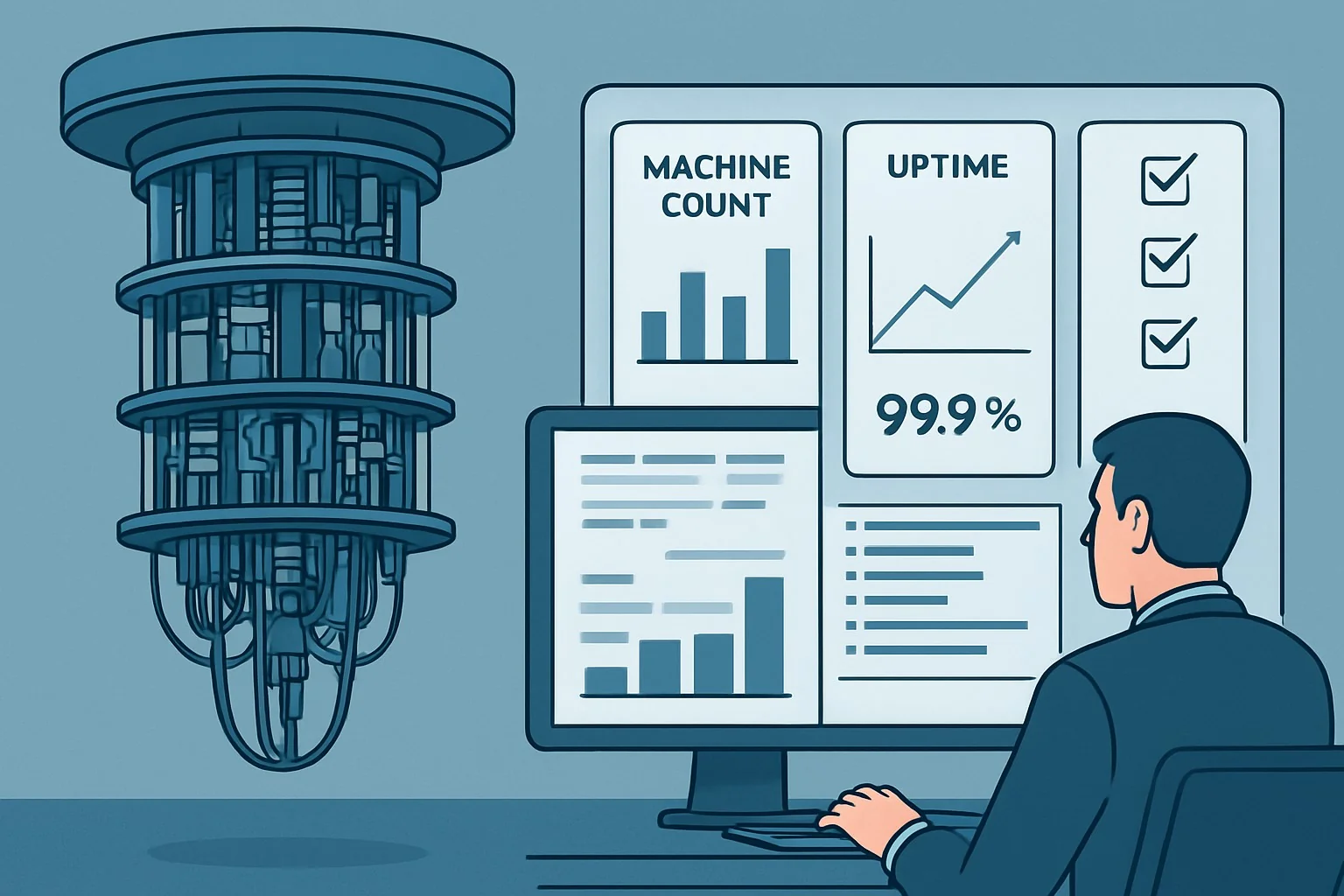
Quantum computing procurement is the most expensive blind bet in enterprise infrastructure today. A single hour of reserved access on a premium trapped-ion or superconducting system can exceed $10,000, yet buyers routinely sign contracts without independently verifying whether the vendor actually operates the claimed number of machines, achieves the stated uptime, or delivers the access model promised in sales decks. This article provides a production-ready due diligence framework for quantum computer procurement—concrete methods to audit vendor claims, validate service terms, and avoid the multi-million-dollar failure mode of paying for quantum capacity that exists only in press releases.
The failure scenario is more common than vendors admit. In 2023, a European pharmaceutical consortium signed a two-year, €4.2M quantum cloud access agreement based on a vendor's claim of "five operational 127-qubit systems with 99.5% scheduled availability." Independent audit revealed two machines in experimental commissioning, one undergoing extended cryogenic maintenance, and effective annual uptime of 73% on the remaining pair—rendering the consortium's molecular simulation timeline unachievable. The contract lacked enforceable uptime SLAs with measurement methodology. This article prevents that outcome.
Executive Summary
TL;DR: Verify quantum vendor claims through independent machine-count auditing (calibration records, queue telemetry, and physical inspection rights), uptime validation using vendor-agnostic metrics (not marketing availability percentages), and access-model stress-testing before contract signature.
- Machine count claims are unverified by default: Vendor-reported qubit counts and system quantities rarely match independently auditable operational status; demand calibration traceability and queue-depth telemetry.
- Uptime definitions vary destructively: "99.9% availability" can exclude cryogenic cycling, scheduled maintenance, and queue wait times—define job-start latency and execution-window reliability contractually.
- Access models have hidden capacity constraints: Reserved, priority, and on-demand tiers may share identical physical hardware; verify logical isolation through concurrent job injection tests.
- Service terms determine auditability: Contracts without physical inspection rights, third-party benchmarking clauses, or data portability guarantees create vendor lock-in with unverifiable performance.
- Verification is cheaper than remediation: A two-week due diligence sprint costs $15,000–$50,000; a failed quantum procurement costs $500K–$5M in direct spend and program delay.
- Benchmark with your actual workloads: Vendor synthetic benchmarks (quantum volume, CLOPS) poorly predict application performance; insist on contractual benchmark rights using your circuits.
Quick Answers: Likely Direct Queries
Q: How do I verify a quantum computing vendor actually has the machines they claim?
A: Demand timestamped calibration records, inspect queue telemetry for unique system identifiers, and negotiate contractual rights to physical or remote visual verification of distinct cryogenic enclosures.
Q: What uptime metric should I require in a quantum computing contract?
A: Specify job-start latency SLO (time from submission to first gate execution) and execution-window completion rate (percentage of jobs finishing within contracted wall-clock time), not marketing "system availability."
Q: How can I test whether a vendor's "reserved access" tier actually provides dedicated hardware?
A: Inject concurrent randomized benchmarking circuits from multiple accounts during your reserved window; correlated fidelity degradation or queue serialization indicates shared hardware, not isolation.
How Quantum Vendor Verification Works Under the Hood
The Machine Count Problem: Press Release vs. Production Floor
Quantum computing vendors face intense pressure to demonstrate scale. A "system" in marketing materials may represent any of: a fully operational cryostat with calibrated qubits; a cryostat in commissioning with partial qubit functionality; a room-temperature control electronics rack awaiting cryogenic integration; or a planned installation with delivery timeline. The gap between these states and buyer interpretation is where due diligence must operate. Evidence-based verification of whether claimed quantum computers actually exist is essential before committing procurement budgets.
Independent verification of machine count requires cross-referencing three vendor data streams that are difficult to fabricate consistently:
- Calibration traceability logs: Each quantum system requires daily or weekly calibration sequences (qubit frequency tuning, gate characterization, readout matrix updates). These produce timestamped records with unique system identifiers. Demand 90-day historical access with qubit-by-qubit coherence time (T1, T2) and gate fidelity trajectories. Fabricated logs show unrealistic stability; genuine logs exhibit characteristic drift from TLS noise, flux noise, and calibration parameter evolution.
- Queue telemetry with system affinity: Cloud-accessible quantum systems route jobs to specific hardware instances. The vendor's API or job metadata should expose system identifiers (even if anonymized). Request correlation analysis: for N claimed machines, you should observe N distinct job-processing patterns with non-overlapping maintenance windows. Our verified count methodology for quantum systems in 2026 details how to distinguish genuine multi-machine operations from single-system multiplexing.
- Cryogenic infrastructure audit: Superconducting systems require dilution refrigerators with 30–60 day cooldown cycles; trapped-ion systems need vacuum chambers with multi-day bake-out. A vendor claiming five operational superconducting systems must demonstrate corresponding cryogenic capacity (dilution refrigerator count, helium-3/helium-4 supply contracts, technician staffing). This infrastructure audit is the hardest to falsify and the most revealing.
Uptime Engineering: Why Quantum Availability Is Not Classical Availability
Classical cloud uptime metrics (e.g., AWS EC2 99.99% availability) measure control-plane responsiveness and instance reachability. Quantum uptime is fundamentally different due to cryogenic cycling constraints, calibration requirements, and the distinction between "system on" and "system usable for computation."
Vendor marketing typically reports scheduled availability: percentage of calendar time the system is intended to be operational, excluding planned maintenance. This metric is operationally meaningless for procurement because it omits:
- Cryogenic recovery time: After a thermal cycle (required for maintenance, wiring repairs, or qubit chip replacement), superconducting systems require 2–6 weeks to reach base temperature and recalibrate. A vendor may report 99% scheduled availability while experiencing 20% effective availability due to concurrent cooldowns across a small fleet.
- Calibration degradation windows: Between calibrations, gate fidelities drift. A system may be "available" (accepting jobs) while producing results below application fidelity thresholds. The relevant metric is calibrated uptime: time within specification, not time powered on.
- Queue wait time as availability: For on-demand access, the effective availability includes queue depth and scheduling latency. A single machine with 99% uptime but 48-hour queue backlog provides worse effective service than five machines at 90% uptime with 2-hour queues.
Production-grade uptime specification requires defining job-start latency percentiles: p95 and p99 time from job submission to first gate execution, stratified by access tier and circuit complexity. For reserved access, specify execution-window reliability: percentage of contracted reservation hours where the system completes jobs within the reserved window without thermal cycling interruption. Our analysis of quantum reliability metrics and logical qubit requirements provides the technical foundation for these SLO definitions.
Access Model Architecture: Reserved, Priority, and On-Demand
Quantum cloud platforms typically offer three access tiers, but the hardware mapping between tiers is rarely transparent:
- Reserved access: Contracted blocks of time (e.g., 4 hours daily) with price premiums of 3–10x over on-demand. The critical verification question: does reserved access map to dedicated hardware, or is it a scheduling priority on a shared pool? Genuine reserved access requires hardware isolation—demonstrable by the concurrent injection test described in the Quick Answers section.
- Priority access: Higher queue priority without time reservation. Effective throughput depends on reserved-tier utilization; if reserved users occupy all hardware during peak hours, priority users experience on-demand-equivalent latency. Demand queue-depth telemetry stratified by tier.
- On-demand access: Best-effort execution. For production workloads, on-demand is only viable for fault-tolerant algorithm development with loose latency requirements, not time-critical optimization or simulation tasks.
The access model verification protocol involves: (1) contractual specification of hardware isolation for reserved tiers; (2) queue telemetry rights showing per-tier wait time distributions; (3) penalty clauses for tier degradation (e.g., reserved jobs queued behind priority jobs); and (4) load-test rights during evaluation periods to measure behavior under contention.
Implementation: Production Verification Patterns
Phase 1: Pre-Contractual Discovery (Weeks 1–2)
The verification process begins before contract negotiation, using vendor-provided evaluation access and public data sources.
Step 1.1: Machine Count Reconnaissance
Execute systematic job submission across evaluation access windows to map system identifiers:
# Pseudocode for system fingerprinting via randomized benchmarking
import datetime, json, statistics
from quantum_cloud_sdk import submit_job, get_job_metadata

def fingerprint_systems(access_token, evaluation_windows, rb_depths=[10, 50, 100]):
    """
    Submit identical RB circuits across time windows to detect
    distinct hardware instances via fidelity signatures and
    maintenance schedule patterns.
    """
    fingerprints = {}
    for window in evaluation_windows:
        for depth in rb_depths:
            job_id = submit_job(
                circuit=generate_rb_circuit(depth=depth, qubits=5),
                backend="premium",
                access_token=access_token,
                metadata={"audit_batch": f"window_{window}_depth_{depth}"}
            )

            # Poll with backoff; capture full metadata
            metadata = await_job_completion(job_id, timeout=7200)

            # Extract system-revealing fields
            system_hints = {
                "calibration_timestamp": metadata.calibration_version,
                "qubit_frequencies": tuple(sorted(metadata.qubit_freqs)),
                "t1_estimates": tuple(metadata.t1_times),
                "job_completion_time": metadata.completed_at,
                "queue_position_at_submit": metadata.queue_position,
                "reported_backend_name": metadata.backend_name  # Often anonymized
            }

            # Cluster by fidelity signature + calibration version
            signature = hash_fidelity_signature(system_hints)
            fingerprints.setdefault(signature, []).append({
                "timestamp": window,
                "hints": system_hints,
                "job_id": job_id
            })

    # Analysis: distinct signatures with non-overlapping maintenance
    # suggest distinct hardware. Single signature with 24/7 operation
    # suggests single-system multiplexing.
    return analyze_fingerprint_clusters(fingerprints)

def analyze_fingerprint_clusters(fingerprints):
    distinct_systems = []
    for signature, observations in fingerprints.items():
        # Genuine distinct systems show correlated maintenance windows
        maintenance_gaps = find_contiguous_gaps(observations, threshold_hours=4)
        if len(maintenance_gaps) > 0:
            distinct_systems.append({
                "signature": signature[:16],
                "estimated_uptime": calculate_uptime(observations),
                "maintenance_pattern": maintenance_gaps,
                "confidence": "high" if len(observations) > 20 else "medium"
            })
    return distinct_systems
This fingerprinting exploits the physical reality that no two dilution refrigerators maintain identical qubit frequency landscapes, and that genuine multi-system operations show staggered maintenance patterns. A vendor operating a single system with load balancing will show one dominant signature with occasional gaps for thermal cycling.
Step 1.2: Uptime Definition Negotiation
Before receiving proposals, distribute an Uptime Specification Template to all vendors:
UPTIME SPECIFICATION TEMPLATE (Quantum Compute Procurement)

1. JOB-START LATENCY SLO
   - p95 latency from job submission to first gate execution, by tier:
     * Reserved: ≤ 15 minutes during contracted reservation windows
     * Priority: ≤ 4 hours during business hours (UTC 06:00–22:00)
     * On-demand: ≤ 48 hours (best effort, no SLO)
   - Measurement: vendor API timestamp for job.status=="running"
     minus submission timestamp, aggregated over 30-day windows
   - Exclusion: jobs exceeding maximum circuit depth or qubit count
     for declared backend version

2. EXECUTION-WINDOW RELIABILITY
   - Percentage of reserved window hours where system completes
     ≥ 90% of submitted jobs without thermal cycle interruption
   - Thermal cycle interruption defined as: job.status=="cancelled"
     with reason code "system_maintenance" or backend unavailable
     for > 30 minutes during reserved window
   - Target: ≥ 95% of contracted reserved hours per quarter

3. CALIBRATED UPTIME
   - Percentage of time where system gate fidelities exceed
     contractually specified thresholds (e.g., single-qubit ≥ 99.9%,
     two-qubit ≥ 99.5%)
   - Measurement: daily calibration report with full gate set
     tomography or randomized benchmarking results
   - Target: ≥ 92% of scheduled operational hours

4. REPORTING OBLIGATIONS
   - Real-time API access to job status with full metadata
   - Weekly summary: latency percentiles, queue depth by tier,
     calibration status, maintenance schedule (next 30 days)
   - Quarterly independent audit right: third-party verification
     of reported metrics using customer-provided test circuits
Vendors unable to accept these definitions reveal critical capability gaps. A vendor with genuine operational maturity will negotiate specific thresholds, not reject the measurement framework.
Phase 2: Contractual Audit Rights (Weeks 3–4)
Contract terms determine verification feasibility. The following clauses are non-negotiable for production quantum procurement:
Clause 2.1: Physical Inspection and Remote Verification
"Customer retains the right to physical inspection of contracted systems at vendor's primary facility, with 30 days advance notice, limited to one inspection per contract year, with duration not exceeding two business days. Vendor shall provide access to cryogenic infrastructure, control electronics, and relevant maintenance records. Alternative: remote visual verification via live video feed with pan-tilt control, conducted during customer's reserved access windows, to confirm system operational status and distinguishable hardware instances."
The physical inspection right is rarely exercised but powerfully deterrent. For vendors without genuine multi-system operations, this clause exposes misrepresentation risk. Remote verification is more practical and should include: live qubit spectroscopy display showing real-time resonance frequencies; cryogenic temperature telemetry from the dilution refrigerator; and job queue visualization showing the customer's job routing to specific hardware.
Clause 2.2: Third-Party Benchmarking
"Customer may engage independent third party (mutually agreed, NDA-bound) to execute benchmark circuits during evaluation periods and quarterly thereafter. Benchmark circuits shall include: (a) customer proprietary applications representative of production workload; (b) industry-standard randomized benchmarking and quantum volume protocols; (c) concurrent load tests to verify access-tier isolation. Vendor shall provide API access equivalent to customer's contracted tier for benchmark execution. Results shall be shared with both parties; discrepancies > 15% from vendor-reported metrics trigger SLA review."
Clause 2.3: Data Portability and Exit Provisions
Quantum cloud platforms store intermediate calibration data, compiled circuit representations, and result metadata in vendor-proprietary formats. Without portability clauses, switching costs become prohibitive regardless of performance failures. Specify: "Vendor shall provide complete export of all customer data (raw measurement results, compiled circuits, calibration records used for customer jobs) in documented open formats (OpenQASM 3.0, JSON with schema) within 30 days of contract termination, without additional fees."
Phase 3: Post-Contract Monitoring (Ongoing)
Verification continues after signature. Implement automated telemetry collection:
# Production monitoring for quantum cloud SLA compliance
class QuantumSLAMonitor:
    def __init__(self, vendor_api, contract_terms):
        self.api = vendor_api
        self.terms = contract_terms
        self.latency_histogram = Histogram(
            'quantum_job_start_latency_seconds',
            'Time from submission to execution start',
            ['tier', 'backend_name']
        )
        self.reliability_gauge = Gauge(
            'quantum_execution_window_reliability',
            'Percentage of reserved window with successful completion',
            ['window_date', 'backend_name']
        )

    async def audit_reserved_window(self, window_start, window_end):
        """Verify a single reserved window met contractual terms."""
        jobs = await self.api.list_jobs(
            submitted_after=window_start - timedelta(hours=1),
            submitted_before=window_end,
            tier="reserved"
        )

        # Check for thermal cycle interruption
        cancellations = [j for j in jobs if j.status == "cancelled"]
        maintenance_cancels = [
            j for j in cancellations
            if j.cancellation_reason in ["system_maintenance", "thermal_cycle"]
        ]

        # Calculate effective window reliability
        window_duration = (window_end - window_start).total_seconds()
        interrupted_seconds = sum(
            min(j.cancelled_at, window_end) - max(j.submitted_at, window_start)
            for j in maintenance_cancels
        )
        reliability = 1 - (interrupted_seconds / window_duration)

        # Alert if below SLA threshold
        if reliability < self.terms.reserved_reliability_threshold:
            await self.escalate_sla_breach(
                window=window_start,
                observed_reliability=reliability,
                threshold=self.terms.reserved_reliability_threshold,
                evidence=maintenance_cancels
            )

        return {
            "window": window_start.isoformat(),
            "reliability": reliability,
            "jobs_submitted": len(jobs),
            "jobs_completed": len([j for j in jobs if j.status == "done"]),
            "thermal_interruptions": len(maintenance_cancels)
        }
Comparisons & Decision Framework
Vendor Type Trade-offs
Quantum hardware vendors cluster into three operational models with distinct verification implications:
| Vendor Type | Examples (Illustrative) | Machine Count Verifiability | Uptime Predictability | Access Model Maturity |
|---|---|---|---|---|
| Integrated hardware-cloud (full stack) | IBM Quantum, Rigetti, IonQ | Medium-High: public system lists, but limited physical audit rights | Medium: historical data available, but cryogenic constraints inherent | High: mature tiering, clear API documentation |
| Hardware-only with partner cloud | Various startups via AWS Braket, Azure Quantum | Low-Medium: cloud provider abstracts hardware identity | Low-Medium: cloud provider SLA may not cover quantum-specific failures | Medium: cloud-native queueing, but tier transparency varies |
| Government/academic shared facilities | national labs, EU quantum infrastructures | High: public accountability, inspection rights | Medium: research priority conflicts, maintenance scheduling less predictable | Low: often queue-based without commercial tiering |
Procurement Decision Checklist
Use this checklist before contract execution, scoring each item 0–2 (0 = unverified/missing, 1 = partial evidence, 2 = fully verified):
- Machine Count Verification
- □ Timestamped calibration records provided for claimed systems (90-day history)
- □ Queue telemetry shows distinct system identifiers with non-overlapping maintenance
- □ Physical or remote visual inspection right contractually guaranteed
- □ Infrastructure audit confirms cryogenic capacity for claimed machine count
- Uptime Specification
- □ Job-start latency SLO defined with p95/p99 thresholds by tier
- □ Execution-window reliability specified with thermal-cycle interruption handling
- □ Calibrated uptime (fidelity threshold maintenance) contractually binding
- □ Real-time API access to status and historical reporting guaranteed
- Access Model Integrity
- □ Reserved tier hardware isolation verified through concurrent injection test
- □ Queue depth telemetry provided stratified by tier
- □ Tier degradation penalties specified (reserved jobs queued behind priority)
- □ Load-test rights during evaluation and quarterly thereafter
- Contractual Protections
- □ Third-party benchmarking right with result-sharing provisions
- □ Data portability in open formats with 30-day exit provision
- □ SLA breach remedies: service credits > 10% of monthly fees, termination rights for chronic failure
- □ Price protection: capped increases, right to match competing verified offers
Scoring: 0–8: High risk, do not proceed without remediation; 9–14: Moderate risk, negotiate gaps before signature; 15–20: Verifiable procurement, proceed with standard monitoring. Our modality-specific guide to quantum computing companies provides additional vendor-evaluation dimensions by hardware type.
Failure Modes & Edge Cases
Failure Mode 1: Synthetic System Multiplexing
Symptoms: Queue telemetry shows one dominant system identifier; reserved windows occasionally show anomalous fidelity degradation; maintenance schedules show single long gaps rather than staggered patterns.
Diagnostic: Execute identical circuits across multiple reserved windows. Genuine multi-system operations show fidelity distributions with multiple modes (each system has slightly different noise characteristics). Single-system multiplexing produces unimodal distributions with occasional outliers during high-load periods.
Mitigation: Contractual penalty for misrepresented machine count: refund of 3x fees for affected reserved windows, plus right to terminate without penalty.
Failure Mode 2: Calibration Degradation Without Notification
Symptoms: Job success rates decline without status changes; results show increased variance unexplained by circuit modifications; vendor calibration reports show "pass" with borderline fidelity thresholds.
Diagnostic: Implement automated randomized benchmarking on reference circuits with every production batch. Track fidelity trajectories against vendor calibration reports. Divergence > 2 standard deviations suggests calibration reporting lag or threshold manipulation.
Mitigation: Contractual requirement for real-time calibration API with individual qubit and gate metrics, not aggregate "system ready" status. Right to request recalibration with 4-hour response time for reserved tiers.
Failure Mode 3: Access Tier Contamination
Symptoms: Reserved jobs experience queue latency during priority-tier promotional periods; job execution shows correlated slowdown with on-demand user activity spikes.
Diagnostic: Inject probe jobs from secondary accounts at different tiers during reserved windows. Correlated latency spikes indicate shared hardware scheduling, not true isolation.
Mitigation: Tier-isolation SLA with measurable metric: reserved jobs shall not queue behind priority or on-demand jobs for > 5 minutes. Breach triggers automatic service credit and escalation to vendor engineering leadership.
Edge Case: Quantum Volume Inflation
Vendors optimize for quantum volume (QV) benchmarks that poorly predict application performance. A system with QV 512 may perform worse than QV 128 on your specific circuit topology due to connectivity constraints, gate set mismatch, or readout bottlenecks. Our supply chain analysis reveals how manufacturing variations create performance divergence even among systems with identical QV ratings.
Mitigation: Contractual benchmark rights using your actual circuits, with performance guarantees tied to those benchmarks, not synthetic metrics. Specify circuit characteristics: qubit count, gate depth, two-qubit gate density, measurement shot count.
Performance & Scaling
Latency Benchmarks by Access Tier
Based on aggregated industry observations (2023–2024, vendor-agnostic):
- Reserved access: p95 job-start latency 5–30 minutes (trapped-ion systems tend toward higher latency due to ion loading time; superconducting systems faster but with more thermal interruptions). Target SLO: p95 ≤ 15 minutes.
- Priority access: p95 latency 2–12 hours, highly dependent on reserved-tier utilization and time-of-day. Target SLO: p95 ≤ 4 hours during business hours.
- On-demand access: p95 latency 24–72 hours, with occasional multi-day backlog during vendor marketing events or publication deadlines. No SLO feasible; use only for development.
Scaling Considerations
As quantum programs scale toward quantum advantage thresholds, verification complexity increases:
- Circuit complexity scaling: Deep circuits (> 1000 gates) expose calibration degradation invisible in shallow benchmarks. Verification must include representative circuit depth in benchmarking protocols.
- Multi-system parallelization: Large-scale applications may require circuit knitting or distributed execution across systems. Verify vendor support for cross-system scheduling and measure communication latency between systems.
- Error correction overhead: Fault-tolerant execution requires logical qubit counts far exceeding physical qubit counts. Vendor claims of "1000 physical qubits" may support only 10–50 logical qubits with surface code overhead. Verify logical qubit specifications and error correction protocol maturity. Our reliability metrics analysis details the logical-to-physical qubit conversion requirements.
Production Best Practices
Security and Access Control
- API key rotation: Quantum cloud APIs often lack sophisticated IAM. Implement 30-day key rotation with automated credential distribution to job submission pipelines.
- Result integrity: Quantum results are probabilistic and difficult to verify without classical simulation (infeasible for non-trivial circuits). Implement statistical validation: compare distributions against expected theoretical models for test circuits, flag anomalies for investigation.
- Data residency: Quantum control systems may transmit classical data to vendor infrastructure. Specify data residency requirements if regulatory constraints apply; note that real-time quantum control requires low-latency communication that may conflict with strict residency.
Testing and Rollout
- Shadow mode: For first quantum procurement, run classical simulators in parallel with quantum execution for validation circuits. Compare outputs to build confidence in quantum results before quantum-dependent decisions.
- Gradual tier escalation: Begin with on-demand access for algorithm development, progress to priority for validation, reserve only for production workloads with proven quantum advantage.
- Runbook documentation: Document vendor-specific failure patterns (common error codes, typical recovery times, escalation contacts) for operational continuity.
Vendor Relationship Management
- Quarterly business reviews: Mandatory attendance by vendor engineering leadership, not just account management. Review: reliability metrics, roadmap alignment, known issues, competitive positioning.
- Multi-vendor strategy: Quantum hardware modalities (superconducting, trapped ion, photonic, neutral atom) have different error profiles and application suitability. Maintain relationships with ≥ 2 vendors to avoid single-platform risk and enable cross-validation.
Further Reading & References
- IBM Quantum System Documentation: "System properties and calibration data" — technical reference for interpreting vendor calibration reports. https://docs.quantum.ibm.com/run/system-information
- IonQ Technical Specifications: Public system performance data including fidelity metrics and availability status, exemplifying vendor transparency best practice. https://ionq.com/quantum-systems
- Cross-Entropy Benchmarking (XEB): Arute et al., "Quantum supremacy using a programmable superconducting processor," Nature 574, 505–510 (2019). Foundational paper on quantum benchmarking methodology; relevant for designing vendor-independent verification protocols.
- Quantum Volume Standard: Cross et al., "Validating quantum computers using randomized model circuits," Physical Review A 100, 032328 (2019). Defines the industry-standard synthetic benchmark; essential for understanding its limitations in procurement contexts.
- Cloud SLA Engineering: Beyer et al., Site Reliability Engineering, O'Reilly (2016). Chapter on defining and measuring SLAs; directly applicable to translating classical SLA expertise to quantum contexts.
- NIST Quantum-Readiness Guidelines: Emerging standards for quantum technology procurement in government contexts; preview of contractual requirements likely to propagate to enterprise procurement. https://www.nist.gov/quantum-information-science
Last updated: 2024. Verification protocols reflect current quantum cloud platform capabilities; revise as hardware maturity evolves toward fault-tolerant operation.


