
Quantum Computer Reliability Metrics: Logical Qubits, Circuit Volum...
Introduction
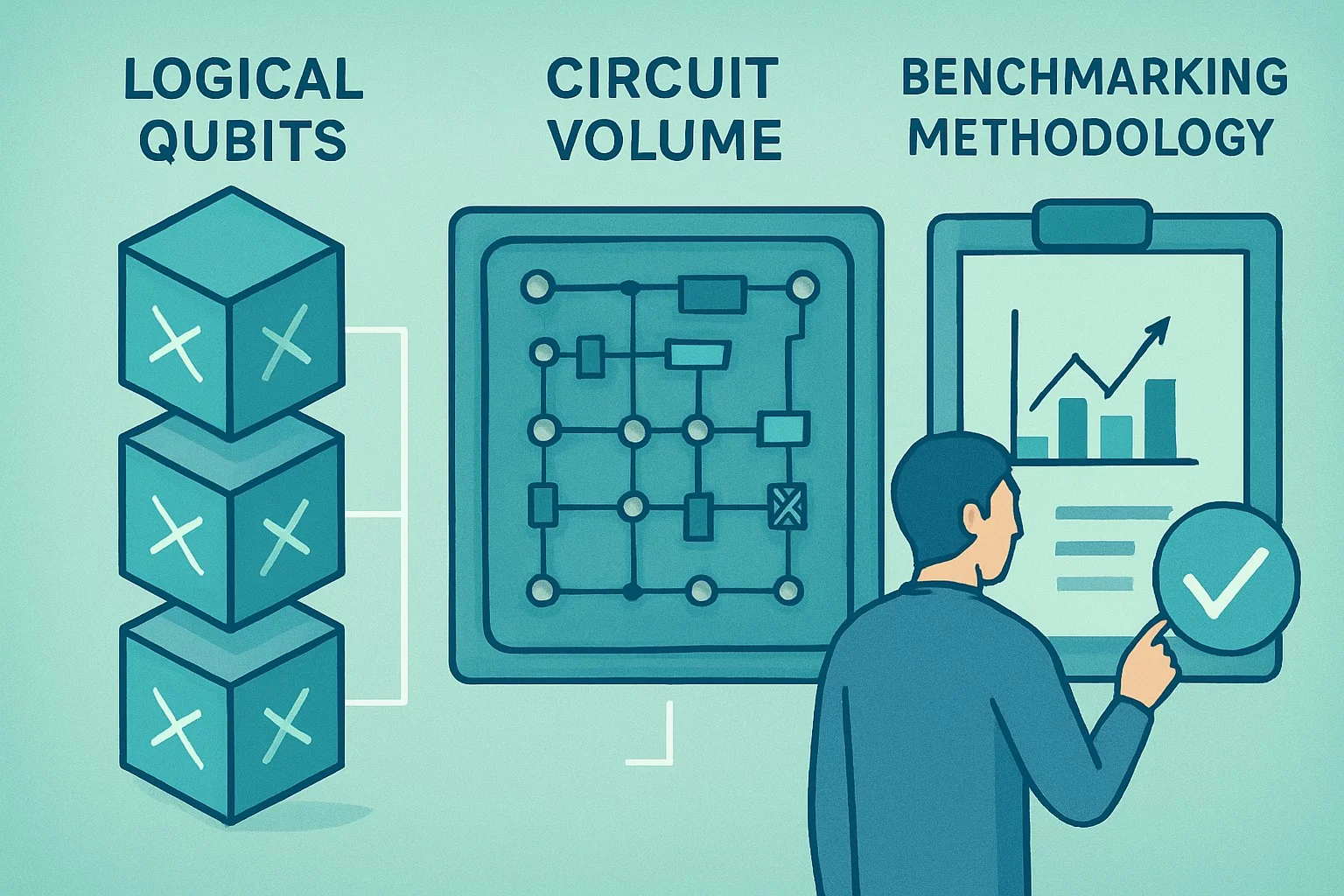
Production quantum computing is no longer a theoretical exercise—IBM's Condor processor ships with 1,121 physical qubits, Google Willow claims sub-10-microsecond error correction cycles, and IonQ's Forte delivers 36 algorithmic qubits. Yet when engineering teams attempt to evaluate which system suits their workload, they face a metrics Tower of Babel: physical qubit counts that obscure usable capacity, circuit volume claims that conflate width and depth, and benchmarking suites that optimize for vendor narratives rather than production fidelity.
This article delivers a disciplined, evidence-based framework for interpreting quantum computer reliability metrics. We dissect logical versus physical qubits, expose how quantum volume and circuit layer operations per second (CLOPS) actually measure distinct capabilities, and establish a benchmarking methodology that separates vendor marketing from engineering reality. If you are selecting quantum hardware for algorithm development, negotiating cloud access terms, or building internal evaluation playbooks, this guide provides the decision structures you need.
Failure scenario: A pharmaceutical team in 2024 selected a 127-qubit system based on physical qubit count alone, only to discover that gate error rates of 10-3 prevented any meaningful molecular simulation beyond 20 qubits of effective circuit width. Six months of algorithm development was invalidated because the team had not evaluated logical error rates or benchmarked against application-relevant circuits. This article prevents such miscalculations.
Executive Summary
TL;DR: Quantum computer reliability cannot be assessed through any single metric; production evaluation requires triangulating logical qubit availability (error-corrected usable capacity), circuit volume (width × depth × gate fidelity constraints), and application-specific benchmarking that stress-tests the exact operations your algorithm requires.
- Physical qubit counts are misleading capacity indicators without gate fidelity, connectivity, and error correction overhead data.
- Logical qubits represent true usable compute capacity but require understanding of code distance, decoder latency, and physical-to-logical overhead ratios (typically 103–104:1 today).
- Quantum volume and CLOPS measure orthogonal capabilities—breadth versus execution velocity—and must be evaluated together.
- Application benchmarks (e.g., QED-C, Q-Score) reveal more than synthetic metrics about real-world algorithmic feasibility.
- Cross-platform comparison requires normalized error rate reporting using identical gate sets and circuit structures.
- 2024–2026 systems remain NISQ-era devices with no commercially relevant fault-tolerant logical qubits deployed; plan for error mitigation, not correction.
Likely direct Q→A pairs:
- Q: How many logical qubits do today's quantum computers actually provide? A: Zero commercially deployed fault-tolerant logical qubits exist as of early 2026; all production systems rely on physical qubits with error mitigation, though Google and IBM have demonstrated prototype logical qubits in research contexts.
- Q: What is a good quantum volume score for production algorithm testing? A: QV ≥ 220 (roughly 1 million) indicates sufficient breadth for intermediate algorithm exploration, but must be paired with CLOPS > 103 for iterative variational algorithms and gate error rates < 10-3 for circuits beyond 50 two-qubit gates.
- Q: Which benchmarking suite best predicts real quantum application performance? A: The QED-C Application-Oriented Benchmarks provide the strongest correlation to production algorithm behavior, though custom circuit families matching your specific gate set and connectivity remain the gold standard.
How Quantum Computer Reliability Metrics Work Under the Hood
Physical Qubits: The Foundation with Hidden Costs
Physical qubits are the quantum mechanical systems—superconducting transmons, trapped ions, neutral atoms, or photonic modes—that store and manipulate quantum information. The headline figure (IBM: 1,121; Google: 105; IonQ: 36) represents raw hardware capacity, but production utility depends on three sub-metrics rarely emphasized in marketing materials:
- Single-qubit gate error rate (ε₁): Typically 10-4 to 10-3 for superconducting systems, 10-5 to 10-4 for trapped ions. Determines baseline coherence preservation.
- Two-qubit gate error rate (ε₂): The critical bottleneck, typically 5×–50× higher than ε₁. Superconducting systems achieve 10-3–10-2; trapped ions 10-3–10-4.
- Connectivity and swap overhead: Limited qubit-to-qubit connectivity (nearest-neighbor in 2D grids for most superconducting architectures) requires SWAP insertion, increasing circuit depth by O(n) for n-qubit operations between distant qubits.
The effective compute capacity of a physical qubit array collapses rapidly with circuit depth. A circuit with d layers of two-qubit gates accumulates error probability approximately Pfail ≈ d × ε₂ × ngates. For ε₂ = 10-3 and 100 two-qubit gates, failure probability exceeds 9%. This is why understanding what quantum computers actually deliver in 2024 requires looking past headline qubit counts.
Logical Qubits: Error-Corrected Usable Capacity
Logical qubits encode one protected quantum information unit across many physical qubits using quantum error correction (QEC) codes. The surface code, dominant in superconducting architectures due to its 2D nearest-neighbor compatibility, requires:
- Physical qubits per logical qubit: 2d² – 1 for distance-d code, where d is the code distance (number of syndrome extraction cycles before logical failure probability dominates). Distance-3 requires ~17 physical qubits; distance-7 requires ~97; distance-17 requires ~577.
- Logical error rate scaling: PL ≈ Pth × (Pphys/Pth)(d+1)/2 below threshold Pth (~10-2 to 10-3 depending on decoder and noise model).
- Decoder latency: Minimum-weight perfect matching (MWPM) decoders run in O(n²) to O(n³) time for n syndrome bits; real-time decoding requires hardware acceleration at kHz syndrome rates for superconducting systems.
Google's 2024 Willow demonstration achieved a distance-5 surface code with logical error rate below physical error rate—a critical milestone. However, this required 105 physical qubits for one logical qubit with limited logical gate capability. The complete error correction stack including decoder architecture determines whether logical qubits are research curiosities or production resources.
Current physical-to-logical overhead ratios of 102–103 (for research demonstrations) to 103–104 (for production-grade distance and connectivity) explain why the count of genuinely useful quantum computers remains far below physical device tallies.
Quantum Volume: Measuring Breadth Under Fidelity Constraints
IBM introduced Quantum Volume (QV) in 2019 to capture the largest square circuit (equal width and depth) a system can execute reliably. The formal definition:
QV = 2min(d,m) where d is the achievable model circuit depth and m is the model circuit width, with success probability ≥ 2/3 averaged over random unitary implementations.
The model circuit structure matters: it uses random permutations of all qubit labels followed by random two-qubit unitaries on pairs, repeated for d layers. This tests:
- Connectivity: Poor connectivity requires SWAP insertion, reducing achievable depth.
- Gate fidelity: Each two-qubit gate introduces error; deeper circuits accumulate more.
- Measurement fidelity: Final state verification requires accurate readout.
- Crosstalk: Simultaneous gate operations must not corrupt neighboring qubits.
IBM's Heron processor achieved QV = 215 = 32,768 in 2024. This is meaningful for algorithm breadth—roughly 15 qubits can participate in fully entangled operations—but says nothing about execution speed or specific gate set performance.
Circuit Layer Operations Per Second (CLOPS): Execution Velocity
IBM introduced CLOPS in 2021 to measure how many model circuit layers execute per second, addressing QV's speed blindness:
CLOPS = (QV layers × shots × circuits) / execution time
Current benchmarks: IBM Heron ~5,000 CLOPS; IBM Eagle ~1,000 CLOPS. This matters enormously for variational quantum eigensolvers (VQE) and quantum approximate optimization algorithms (QAOA), which require thousands of circuit evaluations with classical feedback loops. A system with QV = 220 but CLOPS = 10 cannot run iterative algorithms practically, while a system with QV = 212 and CLOPS = 104 may outperform for specific workloads.
Circuit Volume: Generalized Application Metric
We propose a generalized Circuit Volume (CV) for production evaluation that extends beyond IBM's proprietary definition:
CV = n × d × g × fsucc
Where n = active qubit count, d = circuit depth in relevant gate layers, g = geometric mean of gate fidelities across the specific gate set used, and fsucc = measured success probability on the target algorithm. This application-specific metric collapses to QV for random circuits but provides actionable prediction for production algorithms.
Implementation: Production Patterns
Phase 1: Baseline System Characterization
Before algorithm deployment, establish your target system's true capability profile:
# Pseudocode for systematic capability extraction
# Platform: IBM Qiskit / Qiskit Runtime (adaptable to Braket, Cirq, Q#)

from qiskit import QuantumCircuit, transpile
from qiskit_ibm_runtime import QiskitRuntimeService
from qiskit.quantum_info import random_unitary
import numpy as np

def characterize_system(backend_name, max_width=20, max_depth=20, shots=1024):
    """
    Extract QV-like breadth metric and gate fidelity profile
    for a specific backend with application-relevant gate set.
    """
    service = QiskitRuntimeService()
    backend = service.backend(backend_name)

    # Extract native gate set and connectivity
    basis_gates = backend.configuration().basis_gates
    coupling_map = backend.configuration().coupling_map

    results = {
        'basis_gates': basis_gates,
        'n_qubits': backend.configuration().n_qubits,
        'gate_errors': {},
        'qv_estimate': None,
        'algorithmic_fidelity': {}
    }

    # Phase 1a: Single-qubit and two-qubit gate error extraction
    # Using calibrated error rates from backend properties
    for gate in ['rz', 'sx', 'x']:
        if gate in basis_gates:
            errors = [backend.properties().gate_error(gate, [q])
                     for q in range(backend.configuration().n_qubits)]
            results['gate_errors'][gate] = {
                'median': np.median(errors),
                'p95': np.percentile(errors, 95),
                'p99': np.percentile(errors, 99)
            }

    # Two-qubit gate errors across coupling map
    cx_errors = []
    for edge in coupling_map:
        try:
            cx_errors.append(backend.properties().gate_error('cx', edge))
        except:
            pass
    results['gate_errors']['cx'] = {
        'median': np.median(cx_errors),
        'p95': np.percentile(cx_errors, 95),
        'p99': np.percentile(cx_errors, 99),
        'worst_edge': coupling_map[np.argmax(cx_errors)] if cx_errors else None
    }

    return results
This baseline extraction reveals critical production information: the p95/p99 error spread across qubits (often 2–5× the median due to fabrication variation), and the worst-performing edges in the coupling graph (which must be avoided or routed around).
Phase 2: Application-Specific Circuit Volume Measurement
def measure_algorithmic_circuit_volume(backend, algorithm_circuit_generator,
                                       param_ranges, shots=1024):
    """
    Measure realized circuit volume for your specific algorithm family.

    algorithm_circuit_generator: callable(params) -> QuantumCircuit
    param_ranges: dict of parameter sweeps for VQE/QAOA-style iteration
    """
    from qiskit_ibm_runtime import Session, Sampler

    volumes = []
    fidelities = []

    with Session(backend=backend) as session:
        sampler = Sampler(session=session)

        # Generate parameter sweep
        for params in parameter_grid(param_ranges):
            qc = algorithm_circuit_generator(params)

            # Transpile with optimization for target backend
            transpiled = transpile(qc, backend=backend,
                                 optimization_level=3,
                                 layout_method='sabre',
                                 routing_method='sabre')

            # Extract effective volume metrics
            n_active = len(set(q for inst in transpiled.data
                             for q in inst.qubits))
            depth = transpiled.depth()
            cx_count = transpiled.count_ops().get('cx', 0)

            # Execute and measure success against classical simulable case
            # (for small instances) or known reference state
            job = sampler.run([transpiled], shots=shots)
            result = job.result()

            # Fidelity estimation via reference comparison
            measured_dist = result.quasi_dists[0]
            fidelity = estimate_fidelity(measured_dist, params)

            volumes.append({
                'n_active': n_active,
                'depth': depth,
                'cx_count': cx_count,
                'effective_volume': n_active * depth * fidelity
            })
            fidelities.append(fidelity)

    return {
        'volume_trajectory': volumes,
        'mean_fidelity': np.mean(fidelities),
        'p95_fidelity': np.percentile(fidelities, 95),
        'volume_at_threshold': max(v['effective_volume']
                                  for v in volumes
                                  if v['effective_volume'] > 0.5)
    }
This pattern directly addresses the pharmaceutical team failure scenario: rather than assuming 127 qubits of capacity, it measures how many qubits participate in the actual algorithm circuit, how transpilation inflates depth, and what fidelity is achieved at each parameter point.
Phase 3: Cross-Platform Normalized Comparison
When evaluating multiple cloud providers (IBM Quantum, Amazon Braket, Azure Quantum, Google Quantum AI), normalize metrics to prevent gate-set and compilation differences from distorting comparison:
def normalized_error_rate_comparison(backends, reference_circuit):
    """
    Compare effective error rates across platforms using
    identical circuit structure and normalized gate decomposition.

    backends: list of (provider_name, backend_object) tuples
    reference_circuit: QuantumCircuit in abstract gate set {H, T, CNOT}
    """
    from qiskit.circuit.equivalence_library import SessionEquivalenceLibrary
    from qiskit.transpiler import PassManager, InstructionDurations

    comparisons = []

    for provider, backend in backends:
        # Decompose to provider-native gate set
        if provider == 'ibm':
            basis = ['rz', 'sx', 'x', 'ecr']  # Heron native
        elif provider == 'rigetti':
            basis = ['rx', 'rz', 'cz']
        elif provider == 'ionq':
            basis = ['gpi', 'gpi2', 'ms']
        # ... etc

        # Transpile with identical optimization constraints
        pm = PassManager()
        # Constrain to same effective depth multiplier
        transpiled = transpile(reference_circuit,
                             backend=backend,
                             basis_gates=basis,
                             optimization_level=2,
                             seed_transpiler=42)

        # Measure: native gate count, effective depth, estimated error
        native_gates = transpiled.count_ops()
        effective_depth = transpiled.depth()

        # Error budget estimation from calibration data
        error_budget = estimate_total_error(transpiled, backend.properties())

        comparisons.append({
            'provider': provider,
            'native_gates': native_gates,
            'effective_depth': effective_depth,
            'estimated_error': error_budget,
            'normalized_score': len(reference_circuit.qubits) * \
                               reference_circuit.depth() / \
                               (effective_depth * error_budget)
        })

    return comparisons
Comparisons & Decision Framework
Metric Comparison Matrix
The following structured comparison assists metric selection for specific evaluation scenarios:
- Physical Qubit Count: Best for: capacity planning for future logical qubit availability. Weakness: ignores connectivity, fidelity, and overhead. Use when: negotiating long-term roadmaps with vendors.
- Quantum Volume (QV): Best for: comparing breadth of entanglement capability across similar architectures. Weakness: ignores speed, specific gate sets, and application structure. Use when: initial architectural screening of superconducting candidates.
- CLOPS: Best for: variational algorithm feasibility assessment. Weakness: ignores circuit width and gate fidelity. Use when: evaluating iterative classical-quantum hybrid workloads.
- Algorithm-Specific Circuit Volume (CV): Best for: production workload prediction. Weakness: requires significant benchmarking investment. Use when: committing to specific algorithm deployment.
- Logical Qubit Count (future): Best for: fault-tolerant algorithm planning. Weakness: no production systems available; decoder and connectivity constraints uncertain. Use when: 3–5 year strategic planning only.
Platform Selection Decision Checklist
Evaluate candidate systems against these criteria, weighted by your workload:
- Gate error rate p99 < 2× median? (Critical for uniform circuit performance; high variance indicates fabrication instability)
- Two-qubit gate error < 10-3 for target connectivity pattern? (Threshold for ~100 gate circuits with >50% success probability)
- Native gate set includes your algorithm's dominant operations? (Avoid expensive decomposition; e.g., Toffoli decomposition costs 6–8 two-qubit gates on most platforms)
- CLOPS > 103 for variational workloads; or CLOPS > 104 for real-time control?
- Classical control latency < 100μs for feedback loops? (Required for adaptive VQE, quantum error correction syndrome processing)
- Cloud API supports batch circuit submission with result caching? (Amortizes queue latency, critical for iterative algorithms)
- Vendor publishes full calibration data with historical trends? (Enables predictive scheduling around maintenance cycles)
Failure Modes & Edge Cases
Metric Misinterpretation Failures
Failure: QV Inflation Through Narrow Gate Set Optimization
Some vendors optimize QV circuits using a restricted gate set that does not generalize to user algorithms. Detection: Request QV measurement with your application's native gate decomposition; expect 20–40% reduction in reported QV.
Failure: CLOPS Inflation Through Shallow Circuit Batching
CLOPS scales linearly with shots and circuit count; vendors may report batch-throughput rather than single-circuit latency. Detection: Demand single-circuit, single-shot latency breakdown; production variational algorithms require this path.
Failure: Logical Qubit Count Projection Without Decoder Constraints
Roadmaps project logical qubit counts assuming perfect decoders and fixed physical error rates. Detection: Request decoder latency specifications and measured logical error rate decay with code distance; MWPM decoders fail at scale without hardware acceleration.
Production Edge Cases
Drift-Induced Metric Instability: Superconducting qubit frequencies drift with thermal cycling and two-level system fluctuations. Calibration data stale by >4 hours may misrepresent current capability. Mitigation: Implement pre-job calibration verification and reject backends with >10% parameter drift from published values.
Crosstalk in Dense Qubit Arrays: IBM Condor's 1,121 qubits exhibit measurable crosstalk between non-nearest-neighbor qubits during simultaneous operation. QV measurements typically avoid simultaneous operations; application circuits may not. Mitigation: Benchmark with maximum parallel gate execution patterns matching your algorithm.
Transpilation Non-Determinism: Sabre routing produces variable circuit depths across runs. Fixed seeding helps but does not guarantee optimal routing. Mitigation: Run transpilation 10×, select minimum depth result, and verify equivalence via unitary simulation for small circuits.
Performance & Scaling
Current Benchmark Landscape (2024–2025)
Verified measurements from published vendor data and independent assessments:
- IBM Heron (133 qubits): QV = 215; CLOPS ~5,000; median ε₂ = 6×10⁻⁴; p99 ε₂ = 1.4×10⁻³
- Google Sycamore (70 qubits): QV estimated 214–215; CLOPS not publicly reported; ε₂ ~5×10⁻³ (older generation); Willow upgrade targets 10× improvement
- IonQ Forte (36 algorithmic qubits): No QV equivalent (all-to-all connectivity); two-qubit gate fidelity 99.5% (ε₂ = 5×10⁻³); CLOPS limited by slow gate speed (~10 kHz gate rate vs. ~1 MHz for superconducting)
- QuEra Aquila (256 neutral atoms): Analog mode; no digital gate error metric; relevant for specific Hamiltonian simulation workloads
Scaling Projections and KPIs
For engineering planning, monitor these trajectory metrics rather than snapshot values:
- Physical error rate halving time: Currently ~18–24 months for superconducting two-qubit gates; slower for trapped ions due to fundamental limits.
- Logical qubit demonstration pace: Google distance-5 (2023) to distance-7 (2024); IBM distance-3 (2024); target distance-17 for production relevance requires ~2027–2028.
- Effective quantum volume growth: Historical doubling every 12–18 months; may accelerate with modular architectures (IBM Kookaburra, Google multi-chip).
Monitoring recommendation: Establish quarterly benchmarking of your target platforms using identical circuit suites, tracking not just median performance but p90 degradation (indicating reliability for sustained production use).
Production Best Practices
Security Considerations
Quantum cloud access introduces unique security surface areas:
- Circuit privacy: Cloud providers see full circuit structure. For sensitive algorithms (e.g., proprietary optimization formulations), consider circuit obfuscation techniques or on-premises systems.
- Result integrity: No current cloud platform provides cryptographic attestation of execution on specified hardware. Verify via calibration checks and cross-platform consistency tests.
- API key management: Quantum cloud credentials often grant premium pay-per-shot access; implement least-privilege access and spending limits.
Testing and Validation Runbook
- Pre-flight calibration check: Execute single-qubit randomized benchmarking on all qubits in planned active set; reject if p99 T₁ < 50% of median.
- Connectivity verification: Execute Bell state preparation on all planned two-qubit edges; verify CHSH inequality violation > 2.5 (accounting for readout error).
- Algorithm proxy test: Execute classically simulable instance of target algorithm (e.g., small VQE with exact diagonalization reference); verify fidelity within 20% of error model prediction.
- Batch execution validation: For variational workflows, execute identical parameter set 3×; verify result variance within Poisson shot noise expectation.
Cost Optimization
Quantum cloud pricing varies dramatically by platform and access tier:
- IBM Quantum: Pay-per-shot on premium systems; reserve time for discounted rates. Optimize via circuit batching and dynamic repriorization.
- Amazon Braket: Per-task plus per-shot pricing; IonQ and Rigetti marked up over direct access. Evaluate direct contracts for sustained workloads.
- Hidden cost: Queue latency on popular systems can exceed execution time by 100–10,000×. Budget for hybrid classical-quantum workflow engineering to tolerate asynchronicity.
Further Reading & References
- Cross, A. W., et al. "Validating quantum computers using randomized model circuits." Physical Review A 100.3 (2019): 032328. (Quantum Volume formal definition)
- IBM Quantum. "CLOPS: Measuring the speed of quantum processors." IBM Research Blog, 2021. (CLOPS methodology and initial benchmarks)
- Google Quantum AI. "Suppressing quantum errors by scaling a surface code logical qubit." Nature 614.7949 (2023): 676–681. (Distance-5 logical qubit milestone)
- QED-C. "Application-Oriented Benchmarks for Quantum Computing." github.com/SRI-International/QC-App-Oriented-Benchmarks (Production-relevant benchmark suite)
- Lubinski, T., et al. "Application-oriented performance benchmarks for quantum computing." IEEE Transactions on Quantum Engineering 4 (2023): 1–19. (QED-C methodology paper)
- Bravyi, S., et al. "The future of computing and quantum computing." IBM Quantum Development Roadmap, 2023. (Vendor trajectory with technical specifications)
For readers evaluating whether quantum hardware maturity supports their use case, our evidence-based assessment of current quantum computer existence and capability provides complementary decision support. Those investigating the industrial foundations behind these systems may also find value in examining the quantum computer manufacturing supply chain and its critical bottlenecks.


