
Quantum Benchmarking Methodology: Compare Vendors Without Misleadin...
Introduction
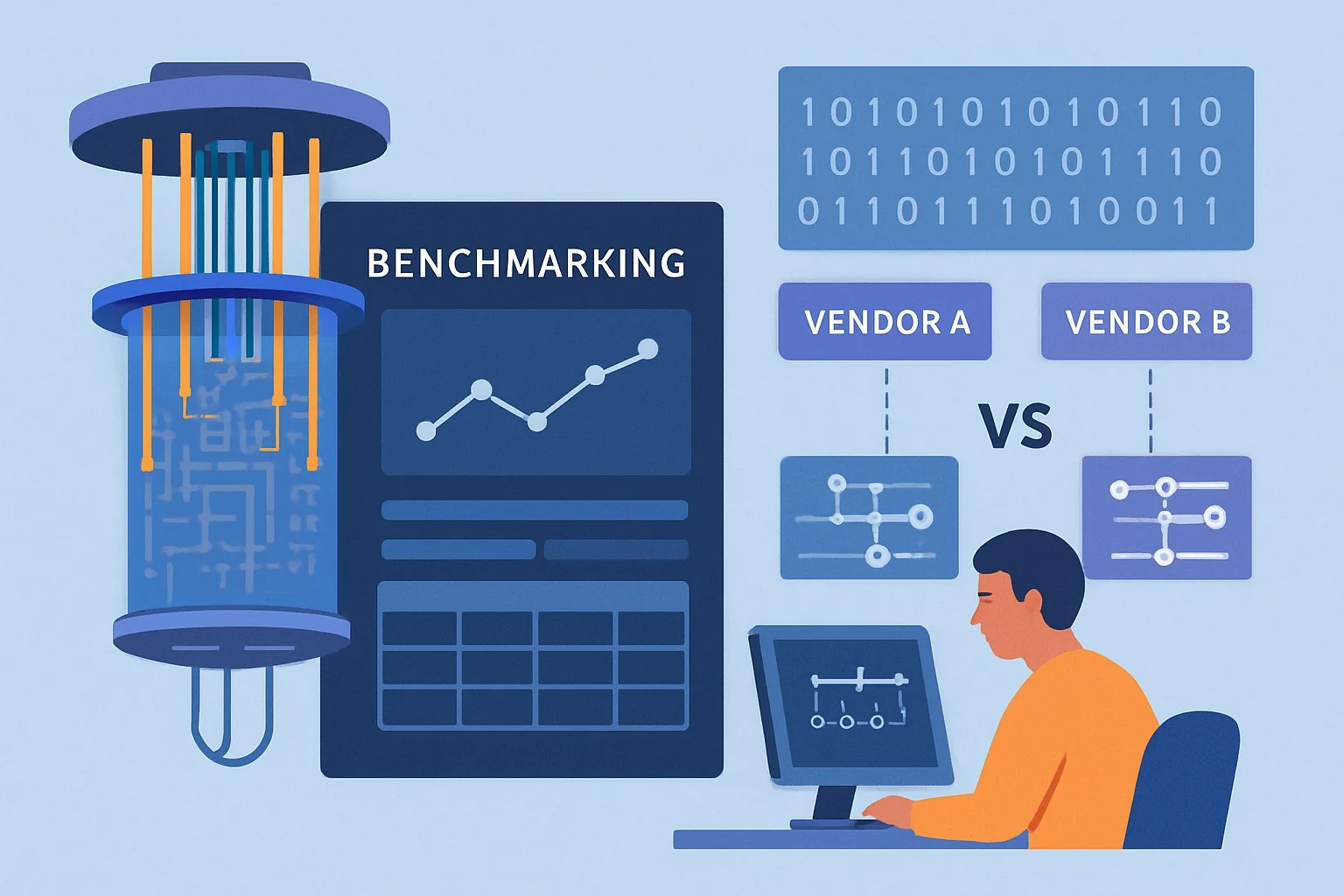
Every quantum vendor publishes headline numbers that look impressive and mean almost nothing in isolation. A procurement team we advised in late 2025 nearly committed $2.3M to a 127-qubit system based on a "quantum volume" score of 128, only to discover during technical due diligence that the device's two-qubit gate fidelity collapsed below 99% on any circuit deeper than 20 layers. The vendor's benchmark was run on a hand-optimized, classically-verifiable circuit that bore no resemblance to their actual workload. This article delivers a rigorous, vendor-neutral quantum benchmarking methodology that exposes misleading metrics and produces reproducible, workload-relevant comparisons.
Executive Summary
TL;DR: Valid quantum benchmarking methodology requires layered evaluation across gate-level physics, circuit-level fidelity, and application-level performance, with explicit controls for circuit structure, classical simulability, and statistical significance.
- Single-number benchmarks (quantum volume, CLOPS) are necessary but insufficient; they must be decomposed into workload-relevant components.
- Gate fidelity without context on crosstalk, coherence time, and gate duration enables vendor cherry-picking.
- Randomized benchmarking (RB) and cross-entropy benchmarking (XEB) answer different questions; using one where the other applies produces misleading comparisons.
- Classical simulability boundaries must be explicitly tested to claim quantum advantage.
- Benchmark protocols must specify circuit depth, qubit connectivity, error mitigation overhead, and shot count to be reproducible.
- Procurement teams should demand benchmark raw data, not just summary scores, and run independent verification on representative problem instances.
Direct Answers:
- Q: What is the most reliable quantum benchmarking methodology for vendor comparison? A: Layered benchmarking combining randomized benchmarking for gate physics, cross-entropy benchmarking for circuit fidelity, and application benchmarks on problem-relevant circuits with published protocols.
- Q: Why is quantum volume misleading as a standalone metric? A: Quantum volume measures the largest square circuit a device can execute reliably, but ignores gate speed, qubit connectivity topology, and performance on non-square circuits that real applications require.
- Q: How should procurement teams verify vendor benchmark claims? A: Demand raw survival probability data, circuit definitions, and shot counts; re-run benchmarks on representative problem instances using open-source frameworks like Qiskit Benchpress or Metriq.
How Quantum Benchmarking Methodology Works Under the Hood
The Layered Evaluation Stack
Effective quantum benchmarking methodology operates across four distinct layers, each answering a different engineering question. Skipping layers or conflating them is the primary source of misleading comparisons.
Layer 1: Physical Qubit Characterization
This layer measures the raw quantum hardware without gates or circuits. Key metrics include T1 (energy relaxation time), T2 (dephasing time), single-qubit frequency stability, and readout fidelity. These are necessary but not sufficient: a qubit with T1 = 500μs is useless if its two-qubit gate fidelity is 95%. Physical characterization enables diagnostic debugging but does not predict application performance.
Layer 2: Gate-Level Benchmarking
Randomized benchmarking (RB) and its variants (interleaved RB, simultaneous RB, gate set tomography) measure gate fidelities in isolation and in parallel. Standard RB estimates the average gate fidelity F_avg by applying sequences of random Clifford gates with varying lengths and fitting the decay of the survival probability. The Clifford twirling property ensures that errors average to a depolarizing channel, enabling efficient estimation.
However, RB has critical limitations: it assumes gate-independent, Markovian errors and cannot detect coherent errors that cancel in Clifford circuits but accumulate in non-Clifford circuits. For quantum error correction (QEC) relevance, decoder-aware benchmarks that measure logical error rates under specific QEC codes are increasingly essential.
Layer 3: Circuit-Level Benchmarking
Cross-entropy benchmarking (XEB) and quantum volume (QV) operate here. XEB compares the measured output distribution against the ideal distribution for random circuits, computing the cross-entropy difference. Unlike RB, XEB exercises non-Clifford gates and circuit structure, making it more representative of variational and sampling algorithms.
Quantum volume, defined by IBM, finds the largest square circuit (n qubits, n layers) that passes a heavy-output generation test with >2/3 probability. The test uses random permutations of all qubits and random two-qubit gates from the SU(4) group, requiring full connectivity or efficient SWAP networks.
The fundamental flaw in isolated QV reporting: it measures only square circuits with uniform gate density. Real algorithms—QPE, QAOA, VQE—have highly non-uniform structure, with critical paths that may be much deeper or sparser than QV circuits. A device with QV=512 may underperform one with QV=256 on your actual workload.
Layer 4: Application-Level Benchmarking
This layer executes problem-relevant circuits with meaningful classical verification. For optimization, this means running QAOA on MaxCut instances with known bounds; for chemistry, VQE on small molecules with FCI comparison; for simulation, Trotterized dynamics on integrable models with exact diagonalization verification. Reliability metrics at the logical qubit level become critical here, as application success depends on sustained coherence across the full algorithm depth.
Benchmark Protocol Anatomy
A reproducible benchmark protocol must specify:
- Circuit family: Explicit gate sequences, not just gate counts. Random circuit benchmarks must specify the randomness distribution and seeding.
- Qubit mapping: Whether the benchmark uses physical qubits directly or requires logical compilation to device topology.
- Error mitigation: Zero-noise extrapolation, probabilistic error cancellation, or none—each changes the fidelity-cost tradeoff dramatically.
- Shot budget: Shot count per circuit and total runtime, as statistical precision and time-to-solution are distinct metrics.
- Success criterion: For sampling, cross-entropy score; for decision, probability of correct answer; for optimization, approximation ratio.
- Classical verification: How the "correct" answer is obtained and at what computational cost.
Implementation: Production Patterns
Pattern 1: Baseline Gate Characterization
Start with standardized RB to establish gate error budgets. Use interleaved RB for critical gates (CNOT, iSWAP, native two-qubit). Report not just F_avg but the error budget breakdown: single-qubit gates, two-qubit gates, measurement, initialization, and idling during classical control latency.
# Pseudocode for standard RB sequence generation
import numpy as np
from qiskit_experiments.library import StandardRB

# Define qubits and sequence lengths
qubits = [0, 1]
num_samples = 10
seed = 42
rb_circuits = []

for length in [1, 10, 20, 50, 100, 200, 500]:
    exp = StandardRB(
        physical_qubits=qubits,
        num_samples=num_samples,
        lengths=[length],
        seed=seed
    )
    rb_circuits.extend(exp.circuits())

# Execute and fit to A * p^m + B for error per Clifford
# Interleaved RB: insert target gate between random Cliffords
Critical production detail: run simultaneous RB on all qubits to measure crosstalk, not just isolated RB. Crosstalk can increase effective error rates by 2-5x on densely connected devices.
Pattern 2: Cross-Entropy Benchmarking for Circuit Fidelity
XEB is essential for algorithms using non-Clifford gates (T, S, Rz rotations). The protocol:
- Generate random circuits with depth d, alternating single-qubit and two-qubit gate layers.
- Single-qubit gates: random rotations from {√X, √Y, √W} where W = (X+Y)/√2.
- Two-qubit gates: apply iSWAP-like gates on pairs determined by a random permutation (for all-to-all) or device topology (for constrained).
- Compute ideal output distribution via classical simulation (feasible for ≤30 qubits, or use tensor network contraction for slightly larger).
- Measure output distribution with N shots; compute cross-entropy difference.
# XEB score computation
def xeb_score(prob_ideal, counts_measured, total_shots):
    """
    prob_ideal: dict of bitstring -> probability from classical sim
    counts_measured: dict of bitstring -> measured count
    Returns: cross-entropy difference (higher = better, 0 = random)
    """
    p_uniform = 1.0 / (2 ** num_qubits)
    H_observed = 0
    H_uniform = 0

    for bitstring, count in counts_measured.items():
        p_ideal = prob_ideal.get(bitstring, 0)
        p_measured = count / total_shots
        H_observed += p_measured * np.log2(p_ideal + 1e-12)
        H_uniform += p_measured * np.log2(p_uniform)

    # Normalize: 0 for random, 1 for ideal
    D = np.log2(2 ** num_qubits) + H_observed  # H_ideal = -log2(D)
    D_uniform = np.log2(2 ** num_qubits) + H_uniform
    fidelity = D / D_uniform if D_uniform != 0 else 0
    return fidelity
Pattern 3: Workload-Driven Application Benchmarking
Translate your actual use case into benchmark instances with verifiable solutions. For QAOA on MaxCut:
- Use standard GSet instances (G1-G81) with known semidefinite programming bounds.
- Run p=1 QAOA with optimized angles, measure approximation ratio achieved.
- Compare against classical Goemans-Williamson (0.878) and brute-force for n≤20.
- Report approximation ratio, circuit depth, gate count, and total runtime including optimization loop.
This pattern prevents the "benchmark gaming" where vendors optimize for synthetic metrics that don't transfer. Our technical due diligence checklist provides a procurement framework for demanding these benchmarks.
Pattern 4: Error-Mitigation-Aware Comparison
Error mitigation (EM) is now standard, but it trades shots for fidelity. A fair comparison must hold either fidelity or total cost constant:
- Fixed fidelity: What is the shot overhead to reach target XEB score on each device?
- Fixed budget: What fidelity does each device achieve with 10^6 shots?
Zero-noise extrapolation (ZNE) requires running at multiple noise levels; probabilistic error cancellation (PEC) requires sampling overhead scaling as 1/γ² where γ is the noise-free circuit probability. Report γ and the resulting shot budget explicitly.
Comparisons & Decision Framework
Benchmark Selection by Use Case
| Use Case | Primary Benchmark | Secondary Benchmark | Critical Control |
|---|---|---|---|
| Quantum error correction | Logical error rate vs code distance | Decoder latency | Code type, syndrome extraction circuit |
| Variational algorithms (VQE/QAOA) | Application benchmark on target problem | XEB on relevant circuit structure | Optimization landscape, barren plateaus |
| Quantum simulation (dynamics) | Trotter error accumulation | RB on T gate fidelity | Trotter step count, Hamiltonian structure |
| Quantum machine learning | Training convergence on benchmark datasets | Effective quantum volume for circuit depth | Data encoding, ansatz expressibility |
| Random circuit sampling (advantage) | XEB at supremacy-scale | Classical verification cost | Circuit volume, classical simulation boundary |
Vendor Comparison Checklist
Before accepting any vendor benchmark claim, verify:
- Protocol publication: Is the full circuit definition, including random seeds, available? Can you reproduce it with open-source tools?
- Qubit count vs. active qubits: Does the benchmark use all advertised qubits, or a hand-selected subset with better performance?
- Circuit structure match: Does the benchmark circuit resemble your application's gate sequence, depth, and connectivity requirements?
- Error mitigation transparency: Is EM applied? What is the shot overhead? What is the unmitigated fidelity?
- Temporal stability: Are benchmarks run once or characterized over hours/days with statistical distributions?
- Classical verification: For non-classically-simulable claims, how is correctness established? (Often: simplified instances, cross-validation, or cryptographic verification.)
For teams evaluating multiple vendors, our 2026 hardware market map organizes systems by underlying qubit modality, which strongly predicts benchmark behavior differences.
Failure Modes & Edge Cases
Failure Mode 1: Coherent Error Cancellation in RB
Randomized benchmarking can report deceptively high fidelities when coherent errors (over/under-rotations) systematically cancel in Clifford circuits. These errors accumulate destructively in non-Clifford circuits like those used in Trotterized simulation. Diagnostic: Run interleaved RB with the target gate both in Clifford and non-Clifford contexts; compare with gate set tomography (GST) for complete error characterization. GST is expensive (O(4^n) for n qubits) but essential for high-stakes verification.
Failure Mode 2: Crosstalk Suppression in Isolated Benchmarks
Vendors often benchmark qubits in isolation or with maximal spatial separation. Production workloads use dense qubit configurations with parallel gate execution. Diagnostic: Demand simultaneous RB on all qubits, and application benchmarks that exercise the full qubit array with realistic scheduling. Measure crosstalk-induced frequency shifts via Ramsey interferometry on spectator qubits during gate operations on neighbors.
Failure Mode 3: Classical Simulability Misclassification
A circuit with 50 qubits and low entanglement may be efficiently simulable by tensor network methods, yet reported as demonstrating quantum computational power. Diagnostic: Benchmark classical simulation cost explicitly using established methods (matrix product states, projected entangled pair states, or tensor network contraction). Report the bond dimension or contraction width required. If classical simulation at the benchmark scale takes <1 hour on a standard GPU cluster, the quantum advantage claim is premature.
Failure Mode 4: Shot-Count Gaming for Sampling Tasks
XEB and heavy-output tests can be passed with surprisingly few shots if the distribution is concentrated. Vendors may report high scores with insufficient statistics for reliable estimation. Diagnostic: Require confidence intervals on benchmark scores, not point estimates. For XEB, the standard error scales as 1/√(N·M) where N is shots per circuit and M is distinct circuits. N·M ≥ 10^4 is a minimum for publication-grade precision.
Failure Mode 5: Temporal Drift and Warmup Artifacts
Superconducting qubits exhibit significant performance variation with thermal cycling, magnetic flux drift, and two-level system (TLS) defect dynamics. A benchmark run immediately after cooldown may not represent steady-state performance. Diagnostic: Characterize benchmarks over ≥72 hours of operation, reporting mean, standard deviation, and worst-case (p95) values. Track T1, T2*, and gate fidelities as time series; correlate with cryogenic system parameters (mixture temperature, helium level).
Performance & Scaling
Metric Scaling Laws
Understanding how metrics degrade with scale is essential for roadmap evaluation:
- Quantum volume: Ideally scales as 2^n; in practice, limited by connectivity and error rates. Current leading devices: QV=512-2048 (n=9-11 effective qubits).
- Circuit layer operations per second (CLOPS): Measures execution speed of QV circuits. IBM's ~1000 CLOPS (2024) vs. theoretical maximum ~10^6 for error-corrected systems. CLOPS without fidelity context is meaningless—a fast wrong answer is still wrong.
- Application approximation ratio: For QAOA, typically decreases with problem size and graph degree. On 3-regular MaxCut with p=1, expect 0.75-0.85 for n=20-100 on NISQ devices, vs. 0.878 classical guarantee.
Statistical Significance Thresholds
For procurement decisions, establish minimum statistical rigor:
- RB: ≥20 random sequences per length, ≥3 lengths spanning exponential decay range, χ²/ndf < 2 for fit quality.
- XEB: ≥100 distinct random circuits, ≥10^4 shots per circuit, report score ± 2σ confidence interval.
- Application benchmarks: ≥10 problem instances per size class, report median and interquartile range (not just best case).
Monitoring and Continuous Verification
Post-procurement, establish automated benchmark pipelines:
# Production monitoring pseudocode
from datetime import datetime, timedelta

class QuantumBenchmarkSuite:
    def __init__(self, backend, schedule):
        self.backend = backend
        self.schedule = schedule  # e.g., daily at 02:00 UTC
        self.history = []

    def run_daily_characterization(self):
        # Fast RB on calibration qubits: ~15 minutes
        rb_results = fast_rb(self.backend, qubits=CAL_QUBITS,
                             lengths=[1, 10, 50], num_samples=5)

        # Application spot-check: one representative instance
        app_result = qaoa_spot_check(self.backend, instance=G1,
                                       p=1, shots=8192)

        # Alert if metrics exceed 3σ from baseline
        self.history.append({
            'timestamp': datetime.utcnow(),
            'rb_fidelity': rb_results.fidelity,
            'app_ratio': app_result.approximation_ratio,
            't1_median': median_t1(self.backend)
        })

        if self._deviation_alert(rb_results.fidelity, 'rb_fidelity'):
            self._escalate("Gate fidelity degradation detected")
Production Best Practices
Security and Benchmark Integrity
Benchmark results can be manipulated at multiple levels: classical simulation substitution, post-selection on favorable random seeds, or selective reporting of time windows. Mitigations:
- Require cryptographically signed raw data with timestamps from trusted execution environments.
- Witness verification: for small instances, verify quantum outputs with independent classical computation.
- Blind benchmarking: provide vendor with encrypted problem instances, decrypt only after results returned, preventing optimization to known benchmarks.
Testing and Rollout
Integrate benchmarking into procurement milestones:
- Technical qualification: Vendor runs standard benchmarks (RB, XEB, QV) with published protocols; customer witnesses or reproduces.
- Application proof-of-concept: Customer provides representative problem instances; vendor demonstrates performance with agreed success criteria.
- Acceptance testing: Extended run (≥1 week) with customer workloads; benchmarks characterize stability and support responsiveness.
- Continuous monitoring: Automated daily benchmarks trigger re-calibration or escalation.
For procurement teams, our guide to verifying vendor claims before purchase provides detailed checklists and contract language for enforceable benchmark commitments.
Runbook: Benchmark Discrepancy Investigation
When customer benchmarks diverge from vendor claims:
- Verify protocol equivalence: identical circuits, gate decompositions, and success metrics.
- Check qubit selection: vendor may use pre-screened qubits; customer uses random or full-array allocation.
- Analyze temporal context: vendor data from optimal cooldown phase; customer data from steady-state operation.
- Inspect error mitigation: vendor may apply undisclosed ZNE or post-selection; customer runs raw.
- Evaluate classical processing: vendor may include sophisticated measurement error mitigation; customer uses simple readout correction.
- Document and escalate: structured discrepancy report with circuit definitions, raw data, and environment parameters.
Further Reading & References
- Cross, A. W., et al. (2019). "Validating quantum computers using randomized model circuits." Physical Review A, 100(3), 032328. The original quantum volume definition with statistical test details.
- Boixo, S., et al. (2018). "Characterizing quantum supremacy in near-term devices." Nature Physics, 14(6), 595-600. Cross-entropy benchmarking theory and practice.
- Moll, N., et al. (2018). "Quantum optimization using variational algorithms on near-term quantum devices." Quantum Science and Technology, 3(3), 030503. Application benchmarking framework for QAOA/VQE.
- Blume-Kohout, R., & Gamble, J. K. (2020). "Volume metrics for quantum computing." arXiv:2003.02354. Critical analysis of volume metric limitations and alternatives.
- Qiskit Benchpress and Metriq platforms: Open-source benchmark suites enabling cross-platform comparison with standardized protocols. https://github.com/qiskit-community/benchpress, https://metriq.info
- Egan, L., et al. (2020). "Fault-tolerant control of an error-corrected qubit." Nature, 598(7880), 281-286. Demonstrates the gap between physical and logical qubit benchmarks.


