
How Many Quantum Computers Exist Worldwide: What Counts
Introduction
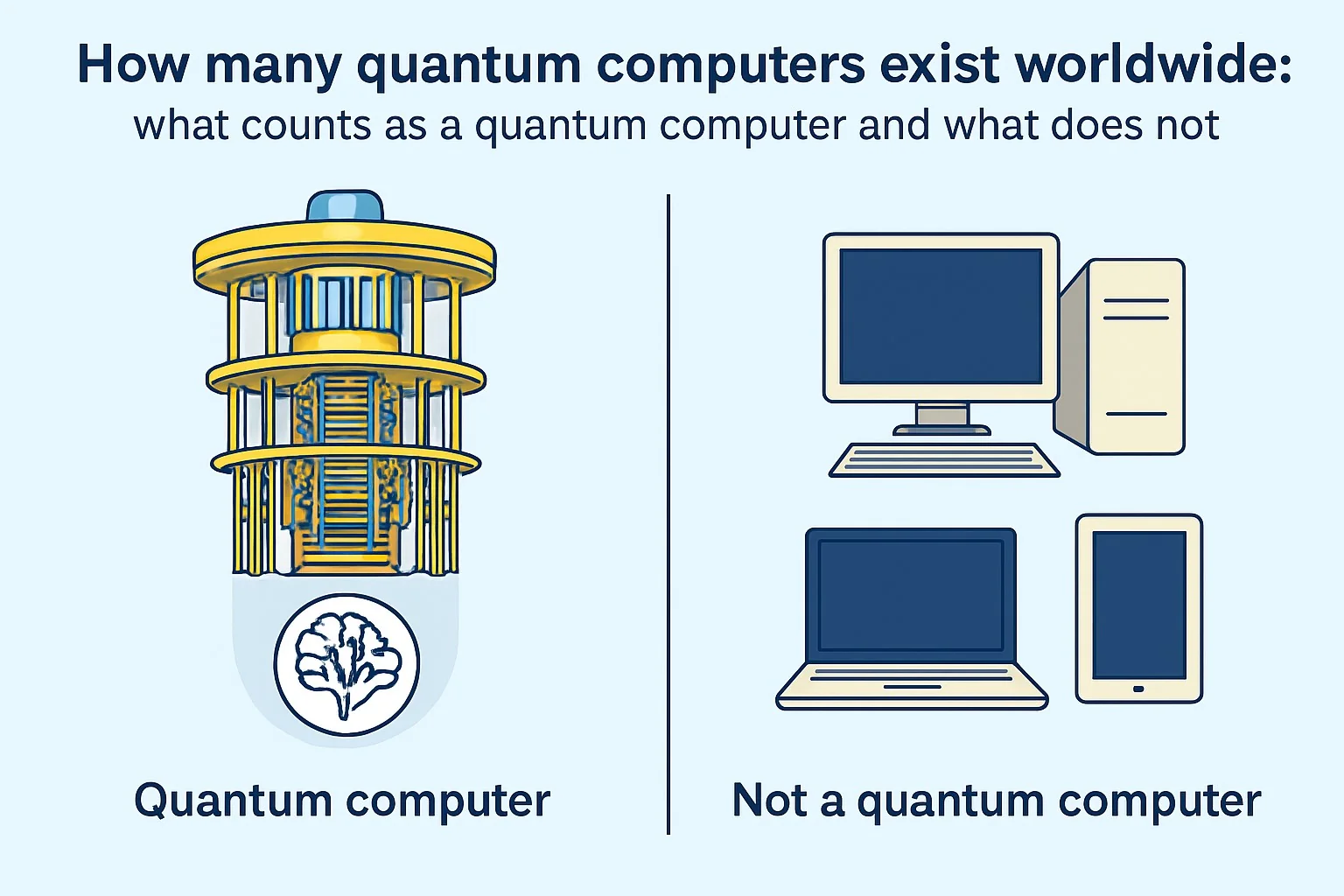
When an engineering team asks "how many quantum computers exist worldwide," they are rarely seeking a headline number. They need a calibrated figure they can defend in procurement reviews, risk assessments, and strategic planning. The problem: the quantum computing landscape conflates laboratory prototypes, cloud-accessible annealers, gate-model processors with <100 qubits, and error-corrected logical systems that do not yet exist at scale. This article delivers a taxonomy-driven inventory method, distinguishes announced systems from installed and operational ones, and provides criteria you can apply to classify any hardware claim.
Failure scenario: A CISO in 2023 approved a post-quantum cryptography roadmap assuming "200+ quantum computers" implied near-term cryptanalytic threat. The figure counted every 5-qubit cloud processor and D-Wave annealer. The actual gate-model systems capable of running Shor-class circuits numbered under 20, with none exceeding 1,000 physical qubits or implementing logical error correction. The roadmap was accelerated by 18 months unnecessarily, burning $2.4M in premature infrastructure migration. Precision in classification matters.
Executive Summary
TL;DR: As of mid-2024, fewer than 50 gate-model quantum computers worldwide meet rigorous operational criteria (programmable, gate fidelity >99%, cloud or on-premise access); if annealers and specialized photonic prototypes are included, the figure rises to roughly 200–300 installed systems, but most cannot run general-purpose quantum algorithms.
- Gate-model vs. annealer distinction is non-negotiable: Only gate-model processors (superconducting, trapped ion, photonic, neutral atom) execute universal quantum circuits; annealers solve optimization problems via quantum-fluctuated energy landscapes and cannot run Shor's or Grover's algorithms.
- "Announced" does not mean "installed": Vendor press releases frequently conflate roadmapped systems with operational hardware. A defensible count requires verification through cloud availability, peer-reviewed benchmarking, or direct procurement.
- Physical qubit count is a misleading metric: Without gate fidelity, coherence time, and connectivity data, qubit counts are marketing artifacts. A 1,000-qubit processor with 95% fidelity is less capable than a 50-qubit system with 99.9% fidelity and all-to-all connectivity.
- Logical qubits remain the threshold for production relevance: No system worldwide has demonstrated sustained logical error correction below the surface-code threshold in a production context; this is the milestone that will redefine "what counts."
- Cloud access democratizes counts but obscures hardware identity: IBM Quantum, Amazon Braket, and Azure Quantum multiplex multiple backend processors; a single cloud endpoint may rotate through 5–10 physical systems.
- Geographic concentration creates supply-chain risk: ~70% of verified gate-model systems are in North America or Europe; East Asian systems (China, Japan, South Korea) are growing but less transparently documented.
Quick Q→A for direct extraction:
- Q: How many quantum computers exist worldwide in 2024? A: 40–50 operational gate-model systems; 200–300 if annealers and specialized prototypes are included.
- Q: Does IBM's 1,000+ qubit Condor processor count as a quantum computer? A: Yes, as a gate-model processor, but its utility depends on gate fidelity and error rates, not qubit count alone.
- Q: Can a D-Wave system break RSA encryption? A: No—D-Wave uses quantum annealing, which cannot implement Shor's algorithm; only universal gate-model systems could theoretically do so, and none are currently capable.
Defining "Quantum Computer": A Taxonomy for Engineers
Before counting, we must define the set. The term "quantum computer" has been applied to devices ranging from 2-qubit university demonstrations to room-sized dilution refrigerators housing 1,000+ superconducting qubits. We propose a functional taxonomy with four tiers, each with distinct inclusion criteria.
Tier 0: Quantum Prototype / Demonstrator
Devices with 2–10 qubits, often single-purpose or manually configured, used for proof-of-principle experiments. Does not count in operational inventories unless cloud-accessible with documented APIs. Examples: early IBM 5-qubit "Yorktown" devices, university ion-trap demonstrations.
Tier 1: Quantum Processing Unit (QPU) — Special-Purpose
Programmable quantum hardware with ≥10 qubits, gate or annealing architecture, accessible via cloud or direct physical connection. Includes D-Wave Advantage (5,000+ qubits, annealer), IBM Falcon/Penguin systems (27–133 qubits, gate-model), and similar. Counts conditionally: must have published benchmark data (e.g., randomized benchmarking, quantum volume, CLOPS) and demonstrated user programs beyond vendor demos.
For a deeper examination of whether current hardware meets the threshold of genuine computational utility, see our evidence-based analysis of what constitutes a real quantum computer.
Tier 2: Universal Gate-Model Quantum Computer
Full-stack system with: (a) universal gate set, (b) ≥20 qubits with median gate fidelity >99%, (c) classical control electronics, (d) high-level programming interface (Qiskit, Cirq, PennyLane, etc.), (e) documented error rates and calibration cycles. Counts as quantum computer for general-purpose computation. Examples: IBM Quantum System One, Google Sycamore, IonQ Aria, Quantinuum H1, Rigetti Aspen.
Tier 3: Error-Corrected / Logical Quantum Computer
System implementing quantum error correction (QEC) with logical qubit error rates below physical qubit rates, demonstrating fault-tolerant operation. Does not yet exist at production scale as of 2024; Google, IBM, and Quantinuum have demonstrated single-logical-qubit prototypes. This tier will redefine the field when achieved.
The engineering trajectory toward this threshold is covered in our technical guide to quantum error correction stacks, which analyzes surface codes, LDPC codes, and decoder architectures.
Excluded Categories
- Quantum simulators (classical): Tensor network or exact diagonalization codes running on GPUs/TPUs. No quantum hardware involved.
- Analog quantum simulators: Cold atom arrays or superconducting circuits engineered for specific Hamiltonians without digital gate decomposition. Useful for physics, not general computation.
- Quantum-inspired algorithms on classical hardware: Simulated annealing, tensor network methods. Marketing often blurs this boundary.
- Announced but unbuilt systems: Roadmap commitments without operational hardware or cloud availability.
Quantum Computer Taxonomy: Gate Model, Annealer, Photonic, and Beyond
The hardware basis fundamentally constrains what a system can compute. We examine the four dominant paradigms with operational examples.
Superconducting Gate Model
Transmon or flux qubits in dilution refrigerators at ~15 mK. Fast gates (~10–100 ns), but short coherence times (~100 μs) and wiring complexity limit scaling. Leading vendors: IBM (127-qubit Eagle, 1,121-qubit Condor), Google (72-qubit Sycamore follow-ons), Rigetti (80-qubit Ankaa), Alice & Bob (cat qubit architecture).
Operational count estimate: IBM maintains ~20+ systems across cloud and on-premise installations; Google operates 2–3 primary research systems; Rigetti has 3–4 operational QPUs. Total superconducting gate-model systems: 25–35 worldwide.
Trapped Ion
Atomic ions in electromagnetic traps, manipulated by laser pulses. Long coherence (seconds to hours), all-to-all connectivity, but slower gates (~10–100 μs) and laser control complexity. Leading vendors: IonQ (Aria, Forte, upcoming Tempo), Quantinuum (H1, H2, 56-qubit systems), Alpine Quantum Technologies.
Operational count estimate: IonQ operates 2–3 primary systems; Quantinuum maintains 4–6 H-series machines across US and UK. Total trapped-ion systems: 8–12 worldwide.
Photonic Quantum Computing
Single photons in waveguide circuits, manipulated by beam splitters and phase shifters. Room-temperature operation, natural networking advantages, but probabilistic gate operations and photon loss. Leading vendors: PsiQuantum (fault-tolerant roadmap, no operational general-purpose system yet), Xanadu (Borealis, 216 squeezed-state modes for Gaussian boson sampling), Quandela.
Operational count estimate: Xanadu's Borealis is a specialized demonstration, not a universal computer; Quandela has 1–2 early systems. Universal photonic quantum computers: 0–2 worldwide at Tier 2.
Neutral Atom
Rydberg-excited atoms in optical tweezer arrays. Flexible reconfiguration, mid-range coherence, emerging gate fidelity. Leading vendors: QuEra (256-qubit Aquila, analog and gate-mode), Pasqal (analog-focused, moving toward digital), Atom Computing (100+ qubit systems).
Operational count estimate: QuEra operates 1–2 Aquila systems (AWS accessible); Pasqal has 2–3; Atom Computing 1–2. Total neutral atom: 4–7 worldwide.
Quantum Annealer
D-Wave systems using superconducting flux qubits for optimization via quantum annealing. Not universal; cannot run Shor, Grover, or general circuits. Operational count: D-Wave has deployed ~15 Advantage systems and maintains earlier 2000Q units. Total annealers: 20–30 worldwide.
For a forward-looking inventory with verified counts and projected growth curves, refer to our 2026 verified quantum computer census, which tracks operational deployments against vendor announcements.
Announced vs. Installed: The Verification Gap
The most common source of inflated counts is the conflation of press releases with operational hardware. We propose a verification protocol for any claimed quantum computer.
Verification Checklist
- Cloud availability: Can an independent user reserve time and execute arbitrary circuits? (IBM Quantum, Amazon Braket, Azure Quantum, IonQ Cloud, Quantinuum UCP qualify.)
- Peer-reviewed benchmarking: Has the system published randomized benchmarking, quantum volume, or application-level benchmarks in a venue with reproducible methodology?
- Physical installation evidence: Photographs, facility documentation, or third-party site visits confirming hardware exists at stated location.
- Customer references: Named commercial or government users with verifiable contracts, not pilot programs.
- Uptime and calibration records: Operational metrics, not just peak performance demonstrations.
Case study: In 2023, a Chinese research group reported a 504-qubit superconducting processor. Independent verification was limited; cloud access was not offered; benchmark data was conference-presented but not peer-reviewed with full error analysis. Under our checklist, this system scores 1/5 and should not be counted in operational inventories until further validation.
Vendor Roadmap Inflation
IBM's 2023 announcement of 1,000-qubit Condor and 2025 roadmap to 4,000+ qubits generated headlines. Condor was delivered and benchmarked (gate fidelity ~95–97%, below prior systems). The 4,000-qubit systems are not yet operational. Counting roadmap milestones as existing hardware is a category error that inflates perceived capability by 10× or more.
The supply-chain constraints that govern how quickly roadmaps become reality are analyzed in our expose on quantum computer manufacturing bottlenecks, covering dilution refrigerator lead times, custom IC fabrication, and cryogenic cable scarcity.
Implementation: How to Audit a Quantum Computer Claim
For engineering teams evaluating vendor claims or building internal inventories, we provide a practical audit workflow.
Step 1: Classify the Hardware Basis
# Pseudocode for hardware classification
def classify_quantum_system(vendor_claim):
    architecture = vendor_claim.get('architecture')
    qubit_count = vendor_claim.get('physical_qubits')
    gate_fidelity = vendor_claim.get('median_1q_fidelity')
    annealer = vendor_claim.get('is_annealer', False)

    if annealer:
        return Tier.ANNEALER, "Optimization-only, not universal"

    if architecture in ['superconducting', 'trapped_ion', 'neutral_atom', 'photonic']:
        if qubit_count >= 20 and gate_fidelity and gate_fidelity > 0.99:
            return Tier.UNIVERSAL_GATE, f"Eligible for general-purpose quantum computation"
        elif qubit_count >= 10:
            return Tier.PROTOTYPE, "Limited utility, research-grade"

    return Tier.INSUFFICIENT_DATA, "Require additional benchmarks"
Step 2: Verify Operational Status
def verify_operational_status(system):
    checks = {
        'cloud_accessible': test_api_endpoint(system.cloud_url),
        'peer_reviewed': search_db(system.name, ['arXiv', 'Nature', 'Science', 'PRX Quantum']),
        'customer_refs': verify_contracts(system.customer_list),
        'uptime_30d': request_sla_metrics(system.vendor),
    }

    score = sum(checks.values())
    if score >= 3:
        return Status.OPERATIONAL_VERIFIED
    elif score >= 1:
        return Status.OPERATIONAL_UNVERIFIED
    else:
        return Status.ANNOUNCED_ONLY
Step 3: Normalize for Comparative Analysis
Raw qubit counts are incomparable across architectures. Normalize using:
- Quantum Volume (QV): IBM's metric; 2^n for n effective qubits. QV 64 = 6 effective qubits.
- Algorithmic Qubits (AQ): IonQ's metric; attempts to capture usable qubits for specific algorithms.
- Circuit Layer Operations Per Second (CLOPS): IBM's speed metric; relevant for variational algorithms.
- Randomized Benchmarking fidelity: Industry-standard gate error characterization.
# Example: Normalized comparison of two systems
systems = {
    'IBM_Eagle': {'physical_qubits': 127, 'QV': 64, 'CLOPS': 1e4, 'gate_fidelity_1q': 0.9995},
    'IonQ_Aria': {'physical_qubits': 25, 'AQ': 25, 'gate_fidelity_1q': 0.9998, 'connectivity': 'all_to_all'},
}

# Effective compute metric (simplified)
def effective_compute(system):
    # Weight fidelity heavily; connectivity matters for algorithm depth
    fidelity_factor = system['gate_fidelity_1q'] ** system.get('physical_qubits', 0)
    # Penalize limited connectivity (superconducting nearest-neighbor)
    connectivity_penalty = 0.5 if system.get('connectivity') == 'nearest_neighbor' else 1.0
    return fidelity_factor * connectivity_penalty * system.get('QV', 1)
Comparisons & Decision Framework: Which Counts for Your Use Case?
The "correct" count depends on your engineering question. We structure four common scenarios.
| Use Case | Relevant Tier | Relevant Architectures | Estimated Count (2024) |
|---|---|---|---|
| Post-quantum cryptography risk assessment | Tier 2+ (universal gate, eventually Tier 3) | Superconducting, trapped ion, neutral atom | 40–50; 0 with logical qubits |
| Optimization (logistics, finance) | Tier 1+ (annealers acceptable) | Annealer, gate-model QAOA | 60–80 (including annealers) |
| Quantum simulation (chemistry, materials) | Tier 2, high qubit count | Superconducting, trapped ion, neutral atom | 30–40 |
| Machine learning research | Tier 2, high CLOPS | Superconducting (IBM, Google) | 15–25 |
| Networking / quantum internet | Tier 1+ (photonic preferred) | Photonic, trapped ion | 5–10 |
Decision Checklist for Procurement Teams
- Define the algorithmic requirement: Does your use case require universal circuits, or is analog optimization sufficient?
- Set fidelity thresholds: For variational algorithms, 99% two-qubit gate fidelity is minimum; for error-corrected algorithms, 99.9% is needed.
- Evaluate cloud vs. on-premise: Cloud access (IBM, AWS, Azure) provides immediate verification; on-premise claims require site audits.
- Demand benchmark transparency: Insist on randomized benchmarking data, not just qubit counts or vendor-specific metrics.
- Assess calibration overhead: Superconducting systems require daily calibration; trapped ion systems are more stable but slower.
Failure Modes & Edge Cases in Quantum Computer Counting
Failure Mode 1: Qubit Count Inflation
Symptom: Vendor claims 1,000+ qubits; actual two-qubit gate fidelity is 95%, rendering effective quantum volume < 100.
Diagnostic: Request randomized benchmarking data for two-qubit gates. Calculate effective qubits from QV or cross-entropy benchmarking.
Mitigation: Normalize all claims to quantum volume or algorithmic qubits before comparison.
Failure Mode 2: Annealer Misclassification
Symptom: D-Wave 5,000-qubit system counted as "quantum computer" for cryptography threat assessment.
Diagnostic: Verify architecture supports universal gate decomposition. Annealers have fixed Hamiltonian evolution, not programmable gates.
Mitigation: Maintain separate taxonomies; never use annealer counts for universal quantum computing threat models.
Failure Mode 3: Cloud Endpoint Multiplicity
Symptom: AWS Braket lists "IonQ" as one backend; actual hardware rotates between multiple IonQ systems with different calibrations.
Diagnostic: Check job metadata for specific device ARN or serial number; compare calibration timestamps.
Mitigation: Track individual physical systems, not cloud service names, in operational inventories.
Failure Mode 4: National Lab Opacity
Symptom: Chinese or Russian government labs claim operational quantum computers without verifiable benchmarks or cloud access.
Diagnostic: Cross-reference with academic publications, patent filings, and satellite imagery of cryogenic facilities.
Mitigation: Apply lower confidence bounds; classify as "unverified" rather than exclude or include definitively.
Performance & Scaling: Metrics That Matter
As systems scale, raw counts become less informative than performance distributions. We characterize the current state.
Gate Fidelity Distributions (p50/p95/p99)
- Superconducting (IBM, Google): p50 two-qubit fidelity ~99.0–99.5%; p95 ~98.5%; p99 ~97.0%. Outliers (Condor) dip to ~95%.
- Trapped ion (IonQ, Quantinuum): p50 ~99.5–99.9%; p95 ~99.0%; p99 ~98.5%. Slower but more uniform.
- Neutral atom (QuEra, Pasqal): p50 ~97–99%; high variance due to atom loss and Rydberg blockade imperfections.
Coherence Time Benchmarks
- T1 (energy relaxation): Superconducting ~100–300 μs; trapped ion ~1–10 seconds; neutral atom ~1–10 seconds.
- T2 (dephasing): Superconducting ~50–150 μs; trapped ion ~0.1–1 second; photonic ~km-scale propagation (effectively unlimited).
Scaling Trajectories
Physical qubit doubling time is currently ~18–24 months, slower than Moore's Law. However, error correction overhead (1,000+ physical qubits per logical qubit for surface codes) means effective logical qubit growth is negative—we are not yet at the point where adding physical qubits increases logical capability. This will invert when physical error rates cross the ~0.1% threshold with sufficient connectivity for low-overhead codes.
The reliability engineering required to reach this threshold is detailed in our analysis of quantum computer reliability metrics, which quantifies logical qubit requirements and circuit volume benchmarks.
Production Best Practices: Building Defensible Inventories
For Enterprise Risk Teams
- Maintain a classified registry: Tag each claimed system with architecture, tier, verification score, and confidence level (verified, unverified, announced).
- Quarterly re-evaluation: Vendor capabilities change rapidly; stale inventories mislead strategic planning.
- Scenario modeling: Model cryptographic threat timelines using logical qubit projections, not physical qubit counts.
For Government & Policy Analysts
- Require transparency for procurement eligibility: Systems without peer-reviewed benchmarks or cloud access should not qualify for national security contracts.
- Fund verification infrastructure: Independent benchmarking centers (like NIST's role in classical computing) reduce information asymmetry.
For Academic Researchers
- Report negative results: Failed experiments on specific systems provide valuable calibration data for inventory accuracy.
- Distinguish system availability: Note whether results used a specific device serial or a rotating cloud backend.
Further Reading & References
- IBM Quantum System One documentation and Qiskit benchmark repository: https://quantum-computing.ibm.com/ — Primary source for superconducting system counts and performance data.
- Google Quantum AI publications: https://quantumai.google/ — Sycamore and subsequent system benchmarks, including 2024 logical qubit demonstrations.
- IonQ public filings (SEC 10-K, investor presentations): — Rare example of vendor transparency on system counts and customer deployments.
- Quantinuum H-series specifications: https://www.quantinuum.com/ — Trapped-ion system performance and commercial availability.
- D-Wave system deployment list: https://www.dwavesys.com/ — Annealer installations, though optimization-only.
- "Quantum computing at the frontiers of biological sciences" (Nature Physics, 2023): — Independent assessment of system capabilities across architectures.
For readers seeking a grounded assessment of what quantum hardware is genuinely available today versus what remains aspirational, our 2024 reality check on quantum computer availability provides a direct examination of operational systems versus marketing claims.